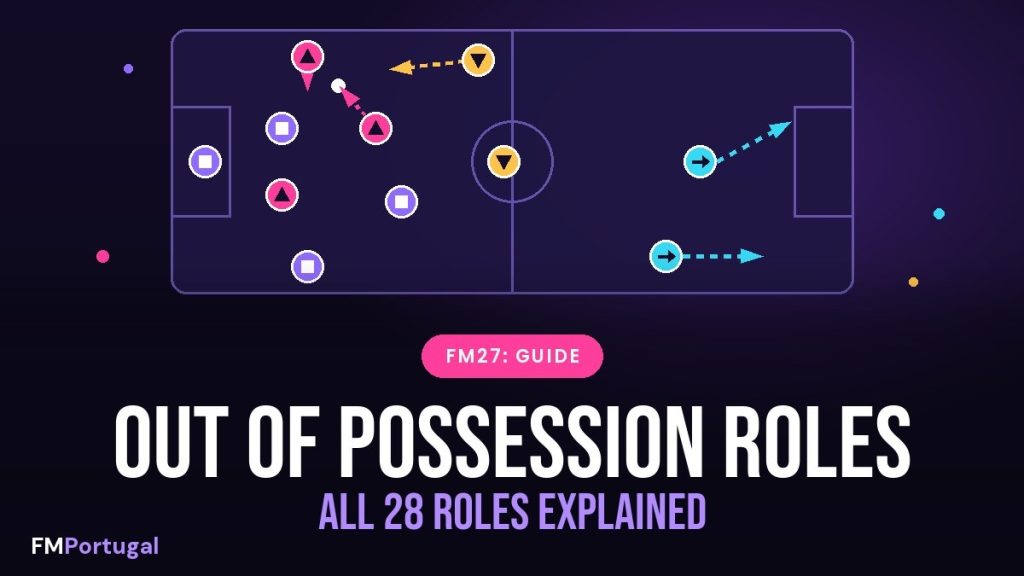
The FM27 out of possession roles decide what each player does when the other team has the ball. In other words, who presses, who holds the line, who drops back to help and who stays high waiting for the counter. The system arrived in FM26 and carries on in FM27 with the same 28 Out of Possession roles. So here is a complete guide, with one image per role, what each one does on the pitch and the attributes that matter most.
How the out of possession roles work
Since FM26, every player has two roles in your tactic. On one hand, the In Possession role says what he does when your team attacks. On the other, the Out of Possession role says how he defends. So a full-back can push on like a wing-back in attack and, once the ball is lost, hold his position next to the centre-backs.
Besides the 28 named roles, every position has a plain version. However, it is the 28 that give your block its personality. In practice, almost all of them fit into four ideas, and the images always use the same colour and symbol for each:
- Steps out to press (pink, triangle): leaves his position to close down the ball.
- Holds and covers (violet, square): stays put, blocks lanes and protects team-mates.
- Tracks back (yellow, downward triangle): drops back to help the defence.
- Stays high (cyan, arrow): saves energy and waits for the counter.
Goalkeepers
Sweeper Keeper
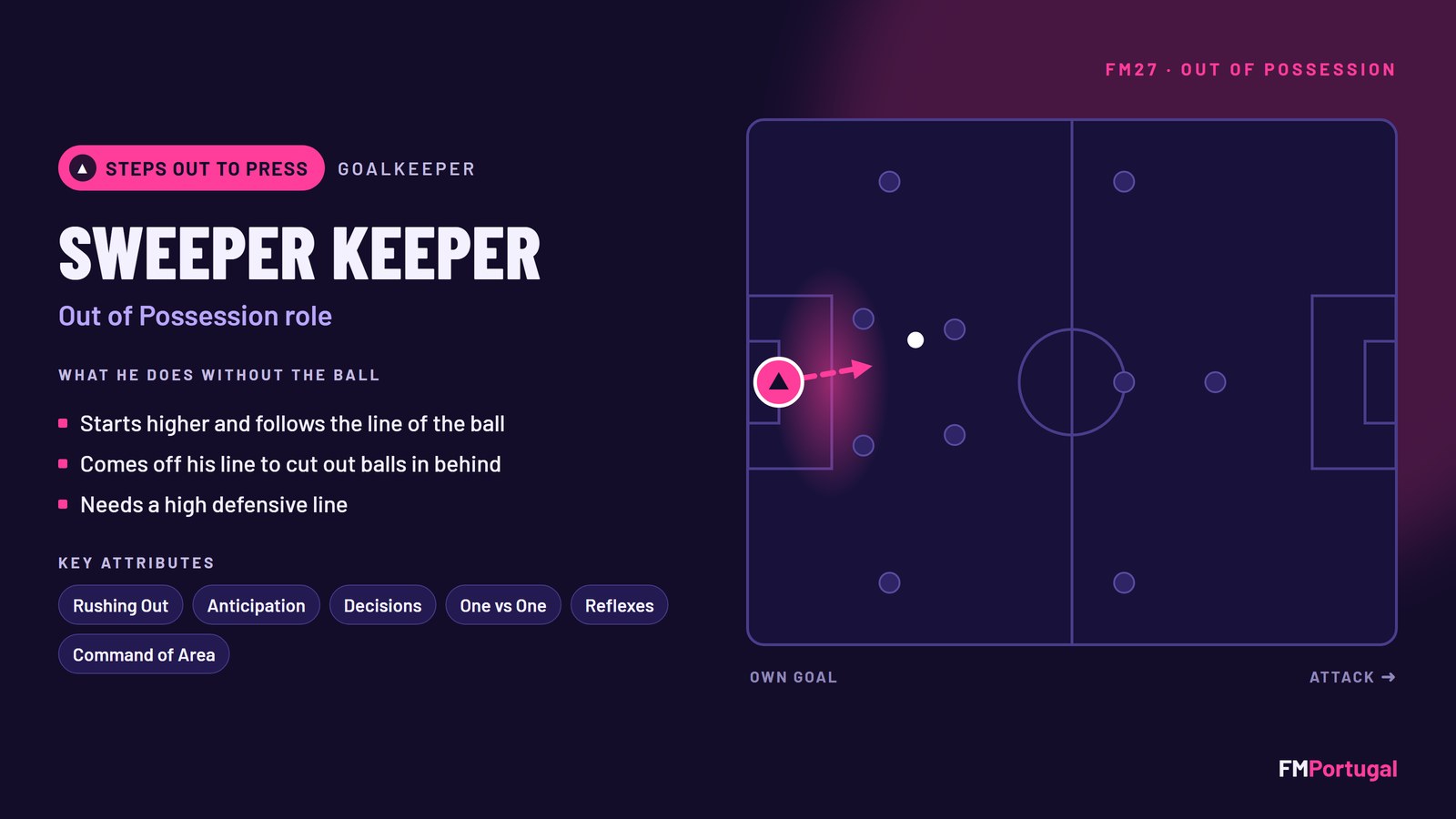
Sweeper Keeper: what he does without the ball (Image: FMPortugal)
He starts higher and moves along the line of the ball, without straying wider than the six-yard box. So, when the opposition try a long ball or a pass in behind, he comes off his line to cut it out before the striker. That is why he only makes sense with a high defensive line. He also needs good Rushing Out, Anticipation and Decisions, or those runs turn into goals.
Line-Holding Goalkeeper
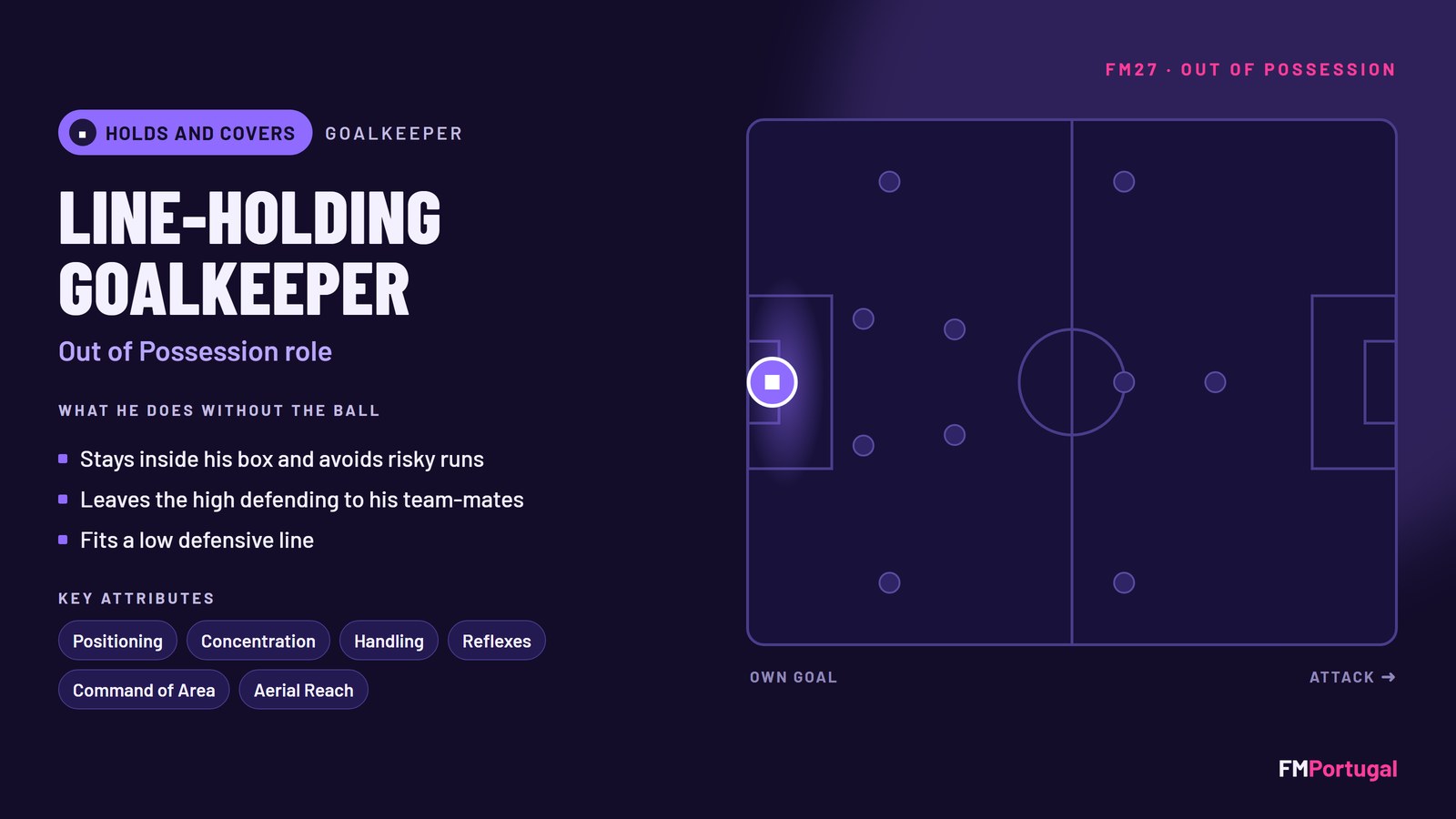
Line-Holding Goalkeeper: what he does without the ball (Image: FMPortugal)
He is the opposite of the previous one: he stays in his box and leaves the work further up to his team-mates. In other words, he avoids risks and focuses on defending the goal. So he fits a low defensive line better, where there is little space in behind to cover. Here, Positioning and Concentration matter most.
Centre-backs
Stopping Centre-Back
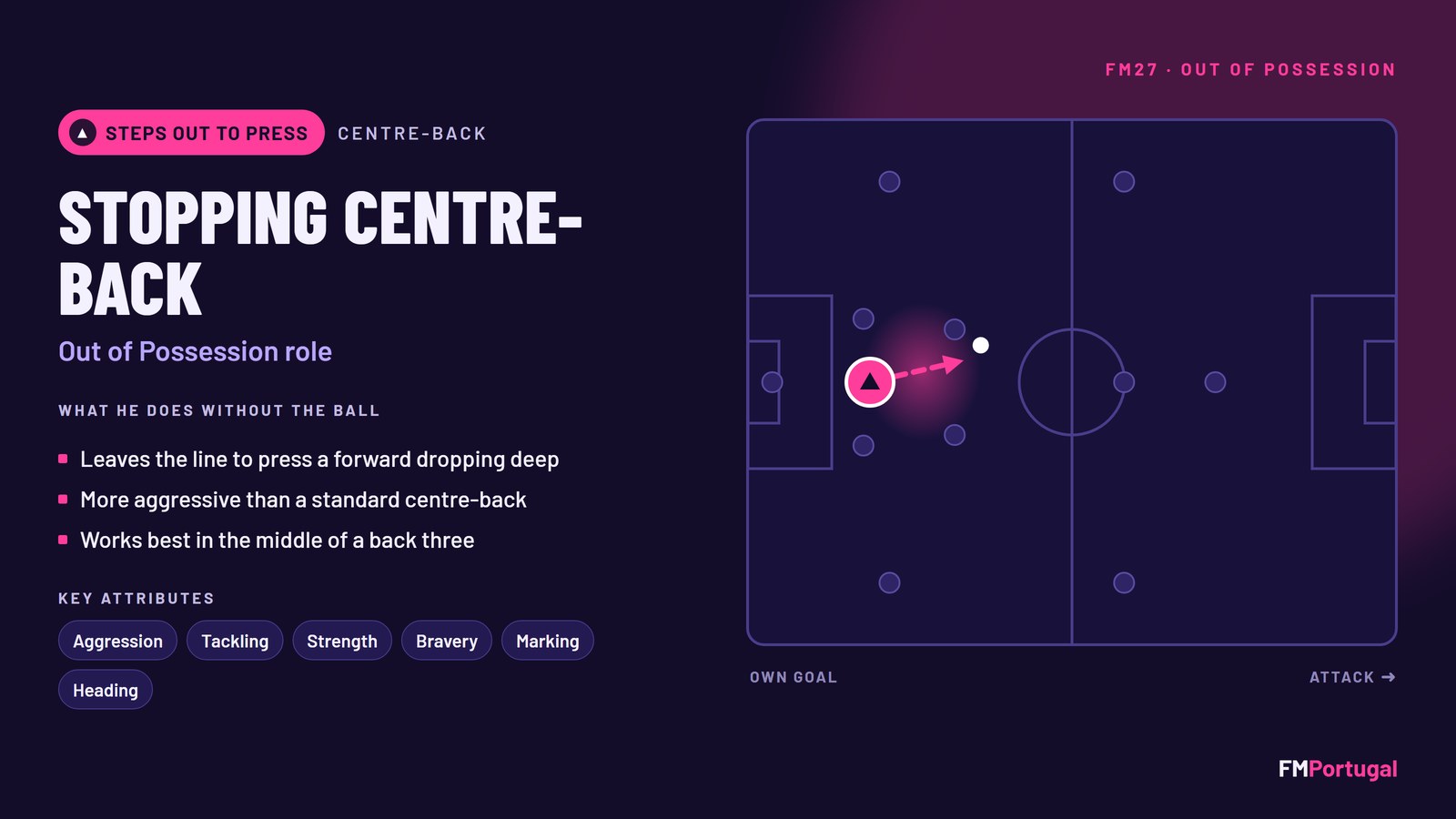
Stopping Centre-Back: what he does without the ball (Image: FMPortugal)
He leaves the line to unsettle forwards and cut attacks out at the source. For example, he is the first to close down a striker dropping deep to receive. So he is more aggressive than a standard centre-back. However, he leaves space behind him: he works best in the middle of a back three, with two team-mates covering. Look for Aggression, Tackling and Strength.
Covering Centre-Back
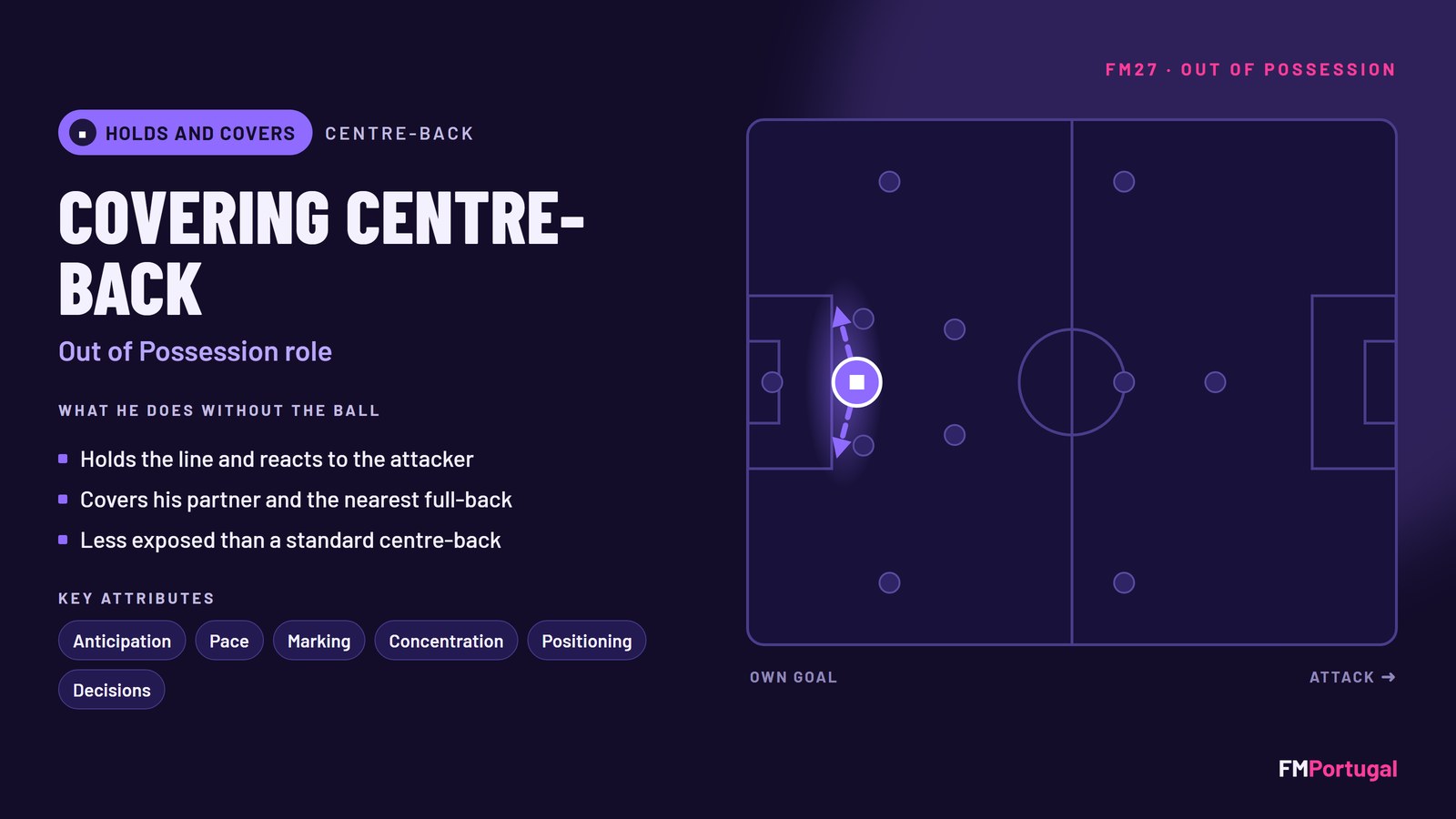
Covering Centre-Back: what he does without the ball (Image: FMPortugal)
He plays more cautiously: he holds the line and waits for the forward to move instead of stepping out. As a result, he offers extra protection behind the defence and helps the full-back or wing-back on his side. That makes him the natural partner for a stopping centre-back. Here, Anticipation, Pace and Marking count most.
Stopping Wide Centre-Back
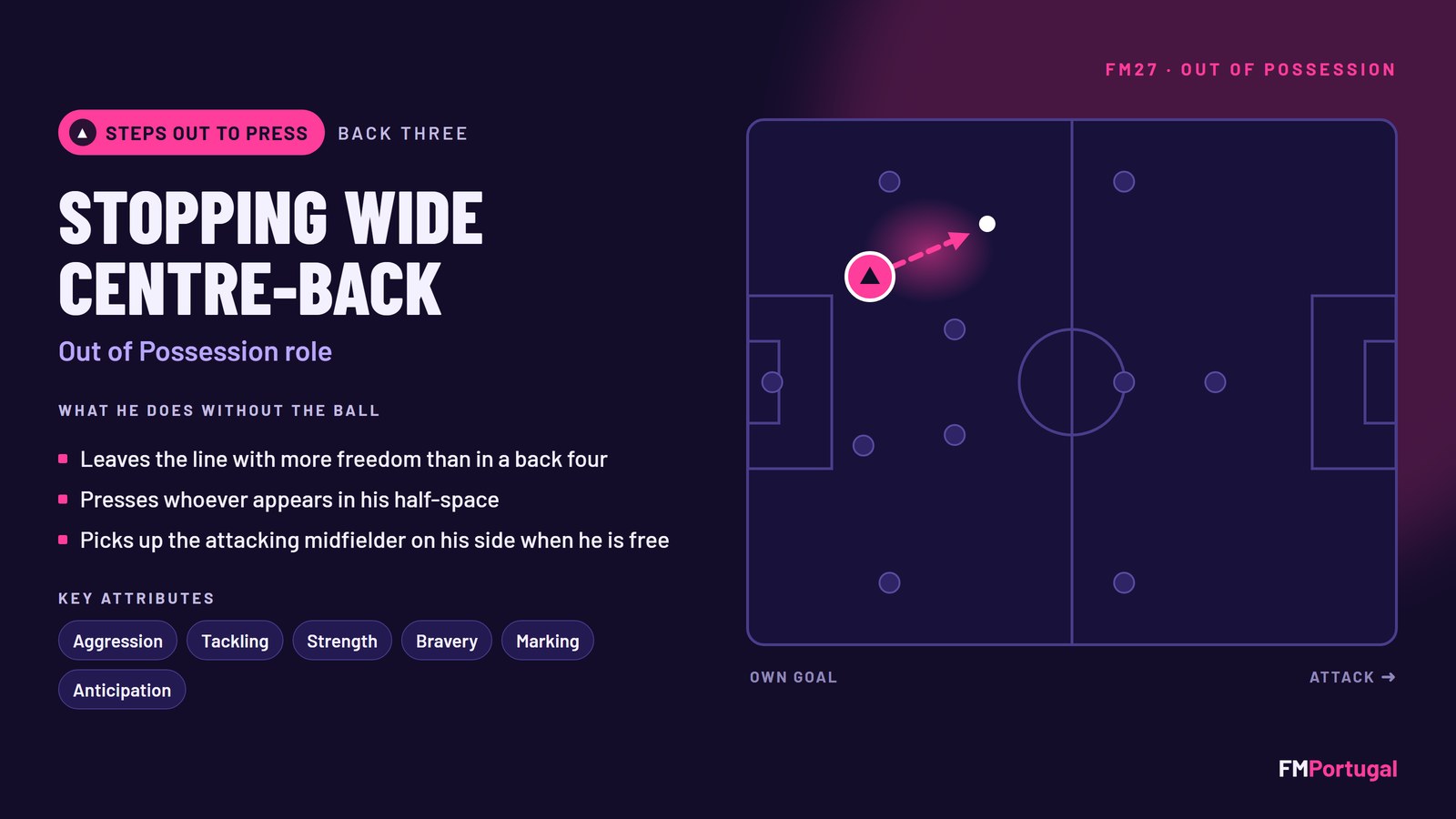
Stopping Wide Centre-Back: what he does without the ball (Image: FMPortugal)
This is the version for the outside centre-backs of a back three. He has even more freedom to leave the line than a standard centre-back and presses mainly in the half-space. For example, he often steps out to the attacking midfielder on his side when that player is free. Like the stopping centre-back, he needs Aggression, Tackling and Strength.
Covering Wide Centre-Back
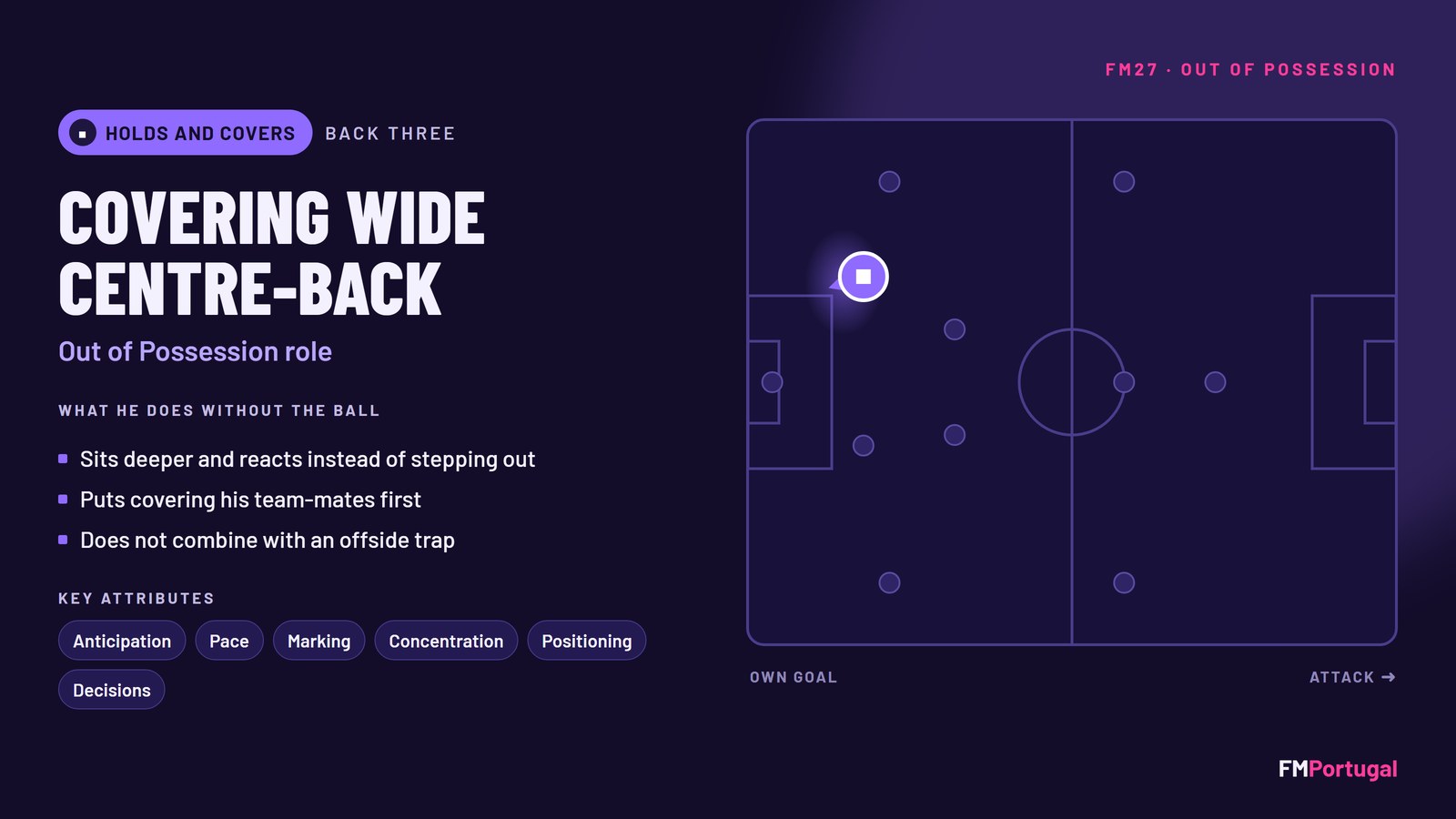
Covering Wide Centre-Back: what he does without the ball (Image: FMPortugal)
He is also for the outside centre-backs of a back three, but does the opposite: he sits deeper and reacts instead of stepping out. So he puts covering his team-mates first. There is one important detail, though: because he plays deeper, he does not combine with an offside trap. Look for Anticipation, Pace and Marking.
Full-backs and wing-backs
Pressing Full-Back
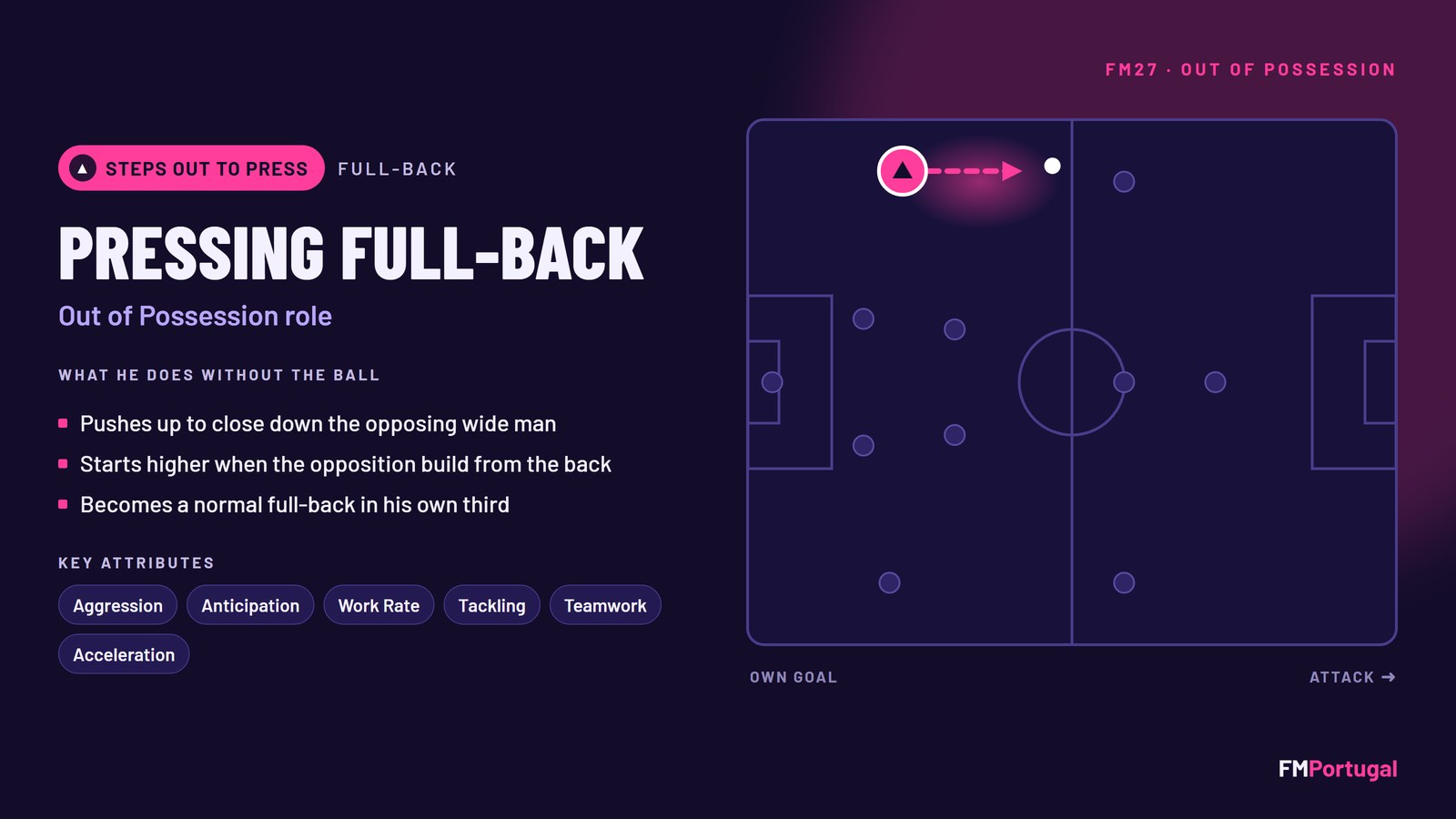
Pressing Full-Back: what he does without the ball (Image: FMPortugal)
He pushes up to close down the opposing wide player high up the pitch and support the team press. So he starts higher when the opposition build from the back and sometimes holds that position even with nobody in front of him. In his own third, however, he goes back to being a normal full-back. Because he leaves space behind, make sure someone covers that side. He needs Work Rate, Anticipation and Aggression.
Holding Full-Back
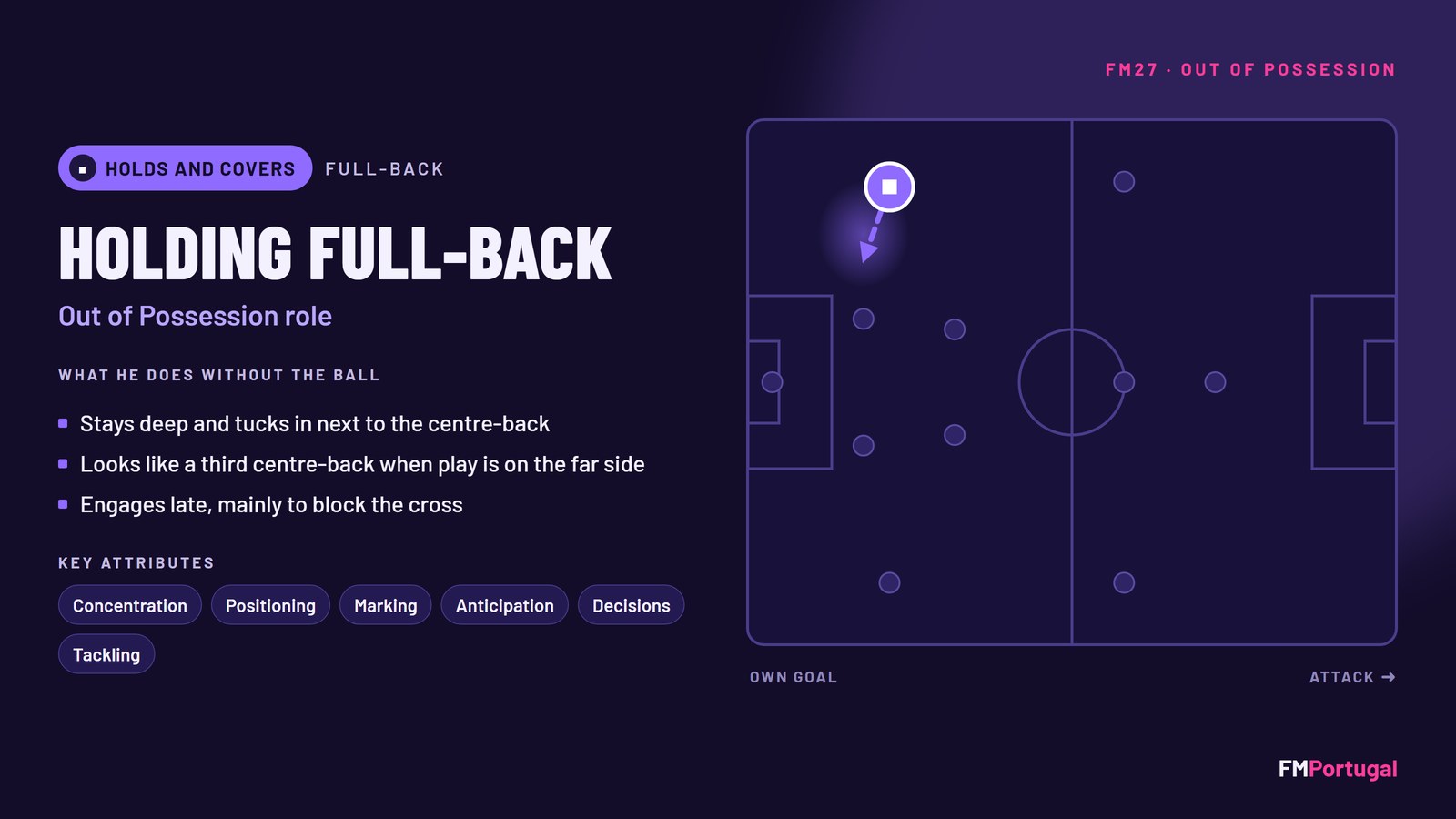
Holding Full-Back: what he does without the ball (Image: FMPortugal)
He stays deeper while the team presses further up, to stop direct attacks. He also tucks in next to the centre-back. For example, with the ball on the far side, he looks like a third centre-back. When the ball comes to his side, he only engages late, usually to block the cross. He works very well with a pressing full-back on the other side. Here, Concentration, Positioning and Marking matter.
Pressing Wing-Back
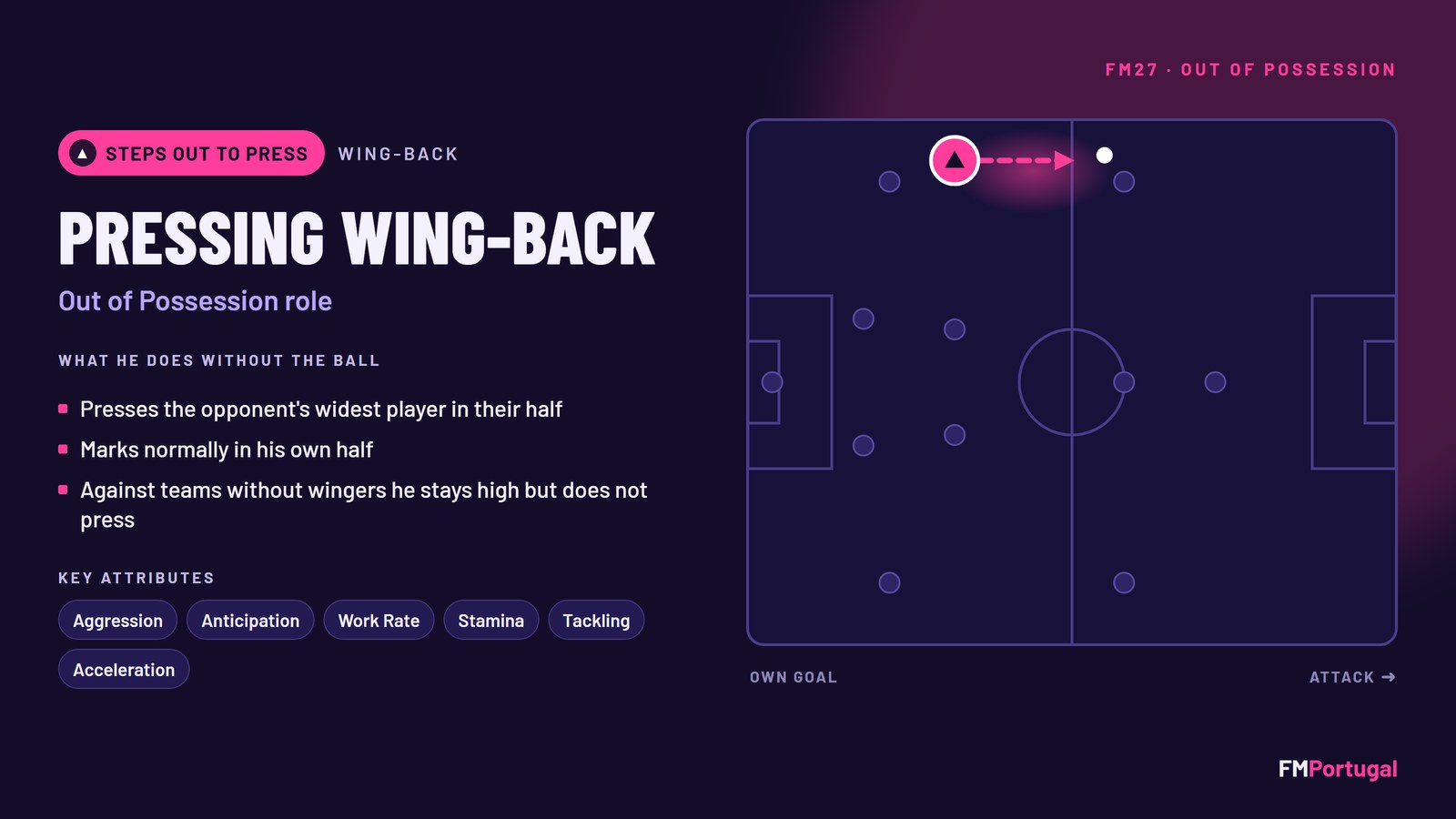
Pressing Wing-Back: what he does without the ball (Image: FMPortugal)
He presses the opponent’s widest player while still in their half. In his own half, though, he marks normally. On the other hand, against teams without wingers, he stays high but does not press and follows the team instructions. Like the pressing full-back, he needs cover behind him, plus Work Rate, Anticipation and Aggression.
Holding Wing-Back
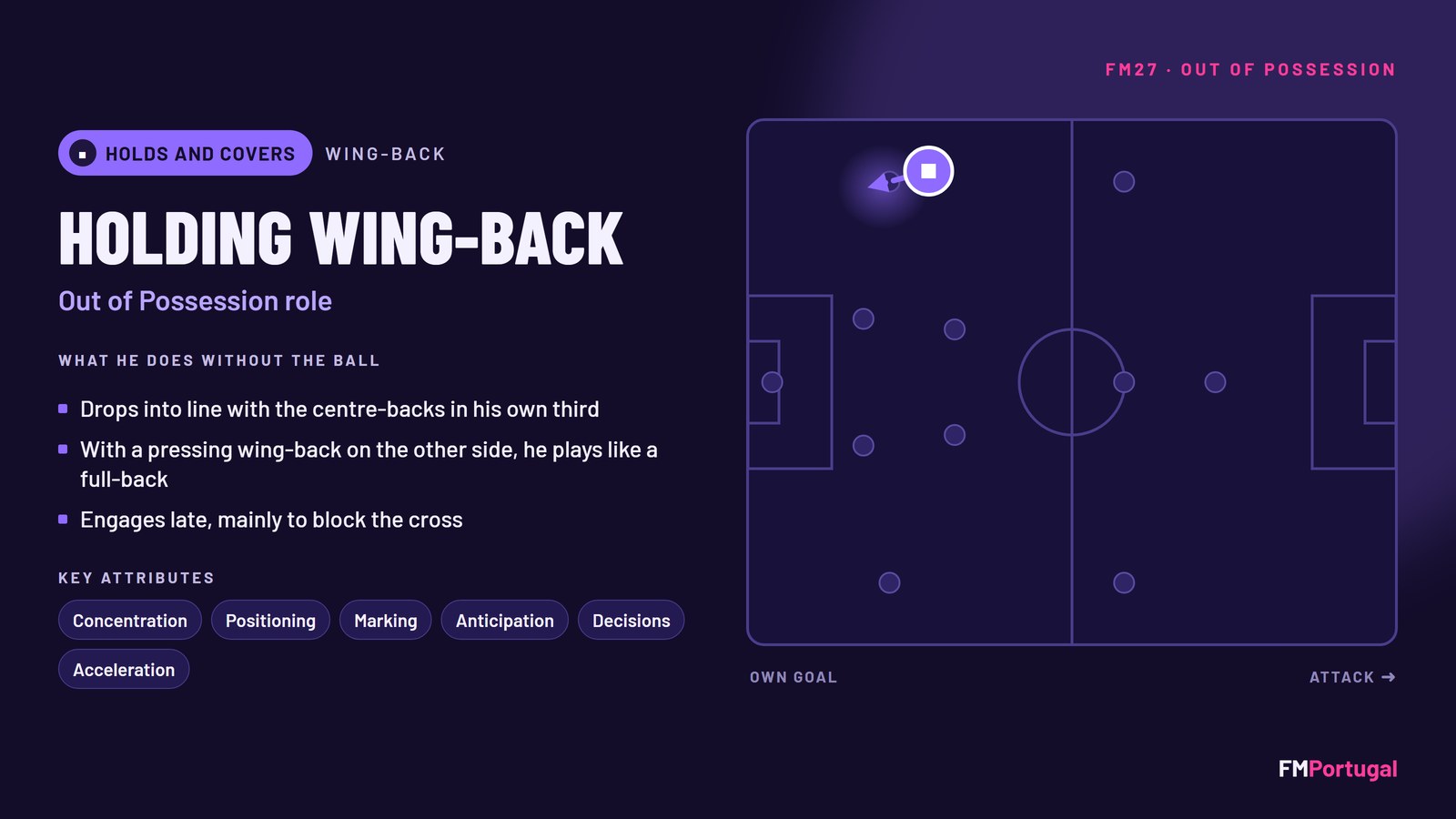
Holding Wing-Back: what he does without the ball (Image: FMPortugal)
He stays deeper to protect the defence instead of pressing. So, in his own third, he lines up with the centre-backs and forms a back five. For example, with a pressing wing-back on the other side, he plays almost like a traditional full-back. Like the holding full-back, he only engages late to stop the cross. He needs Concentration, Positioning and Marking.
Defensive midfielders
Pressing Defensive Midfielder
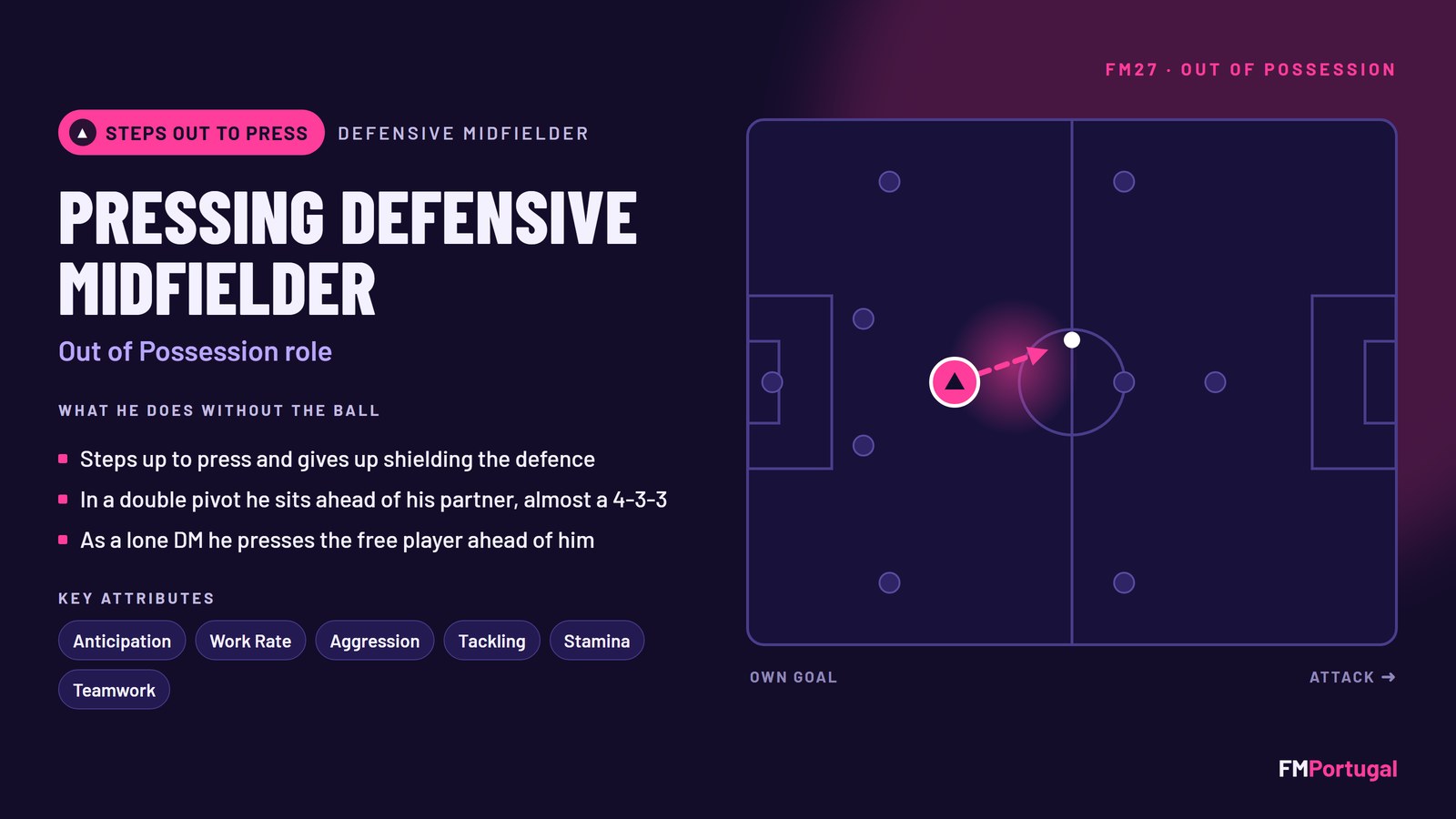
Pressing Defensive Midfielder: what he does without the ball (Image: FMPortugal)
He steps up to support the high press and starts higher when the opposition build from the back. In other words, he trades shielding the defence for aggression. In a double pivot he sits ahead of his partner and the shape looks like a 4-3-3. On his own, he presses the free player ahead of him. So make sure there is cover behind him, plus Anticipation, Work Rate and Aggression.
Dropping Defensive Midfielder
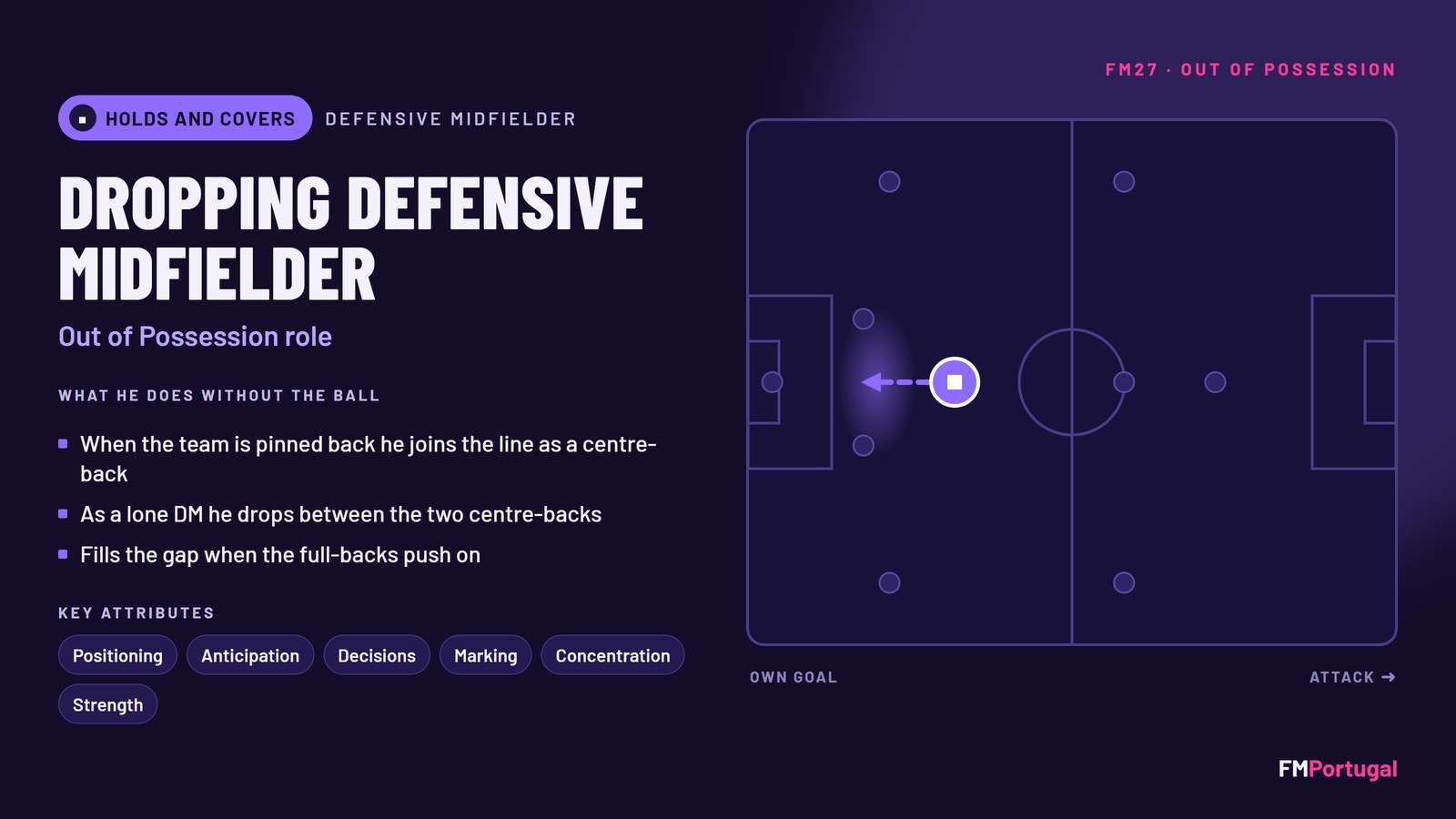
Dropping Defensive Midfielder: what he does without the ball (Image: FMPortugal)
When the team is pinned back near the box, he joins the back line as an extra centre-back. Further up, he plays as a normal defensive midfielder. His position depends on the shape: alone, he drops between the two centre-backs; in a double pivot, he slots in on the side of the centre-back nearest to him; and in a back three, between the central and the wide centre-back. So he is great when your full-backs push on a lot. Look for Positioning, Anticipation and Decisions.
Screening Defensive Midfielder
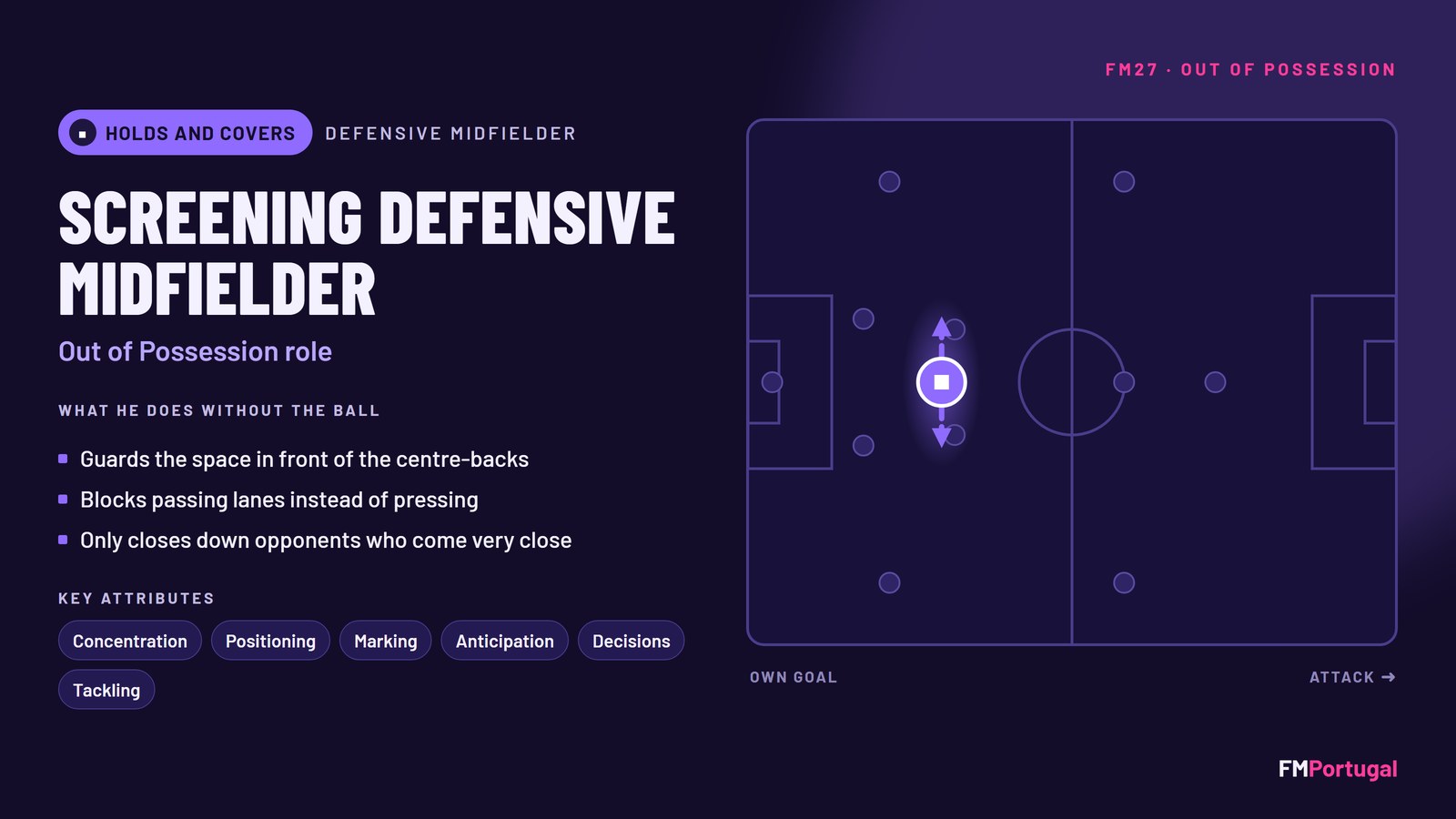
Screening Defensive Midfielder: what he does without the ball (Image: FMPortugal)
He defends the space in front of the centre-backs and rarely leaves his position. Instead of pressing, he blocks passing lanes and only closes down opponents who come very close. So he stays disciplined all over the pitch. Alone, he stays central; in a pair, he shifts slightly to one side, but without stepping out. Here, Concentration, Positioning and Marking count most.
Wide Covering Defensive Midfielder
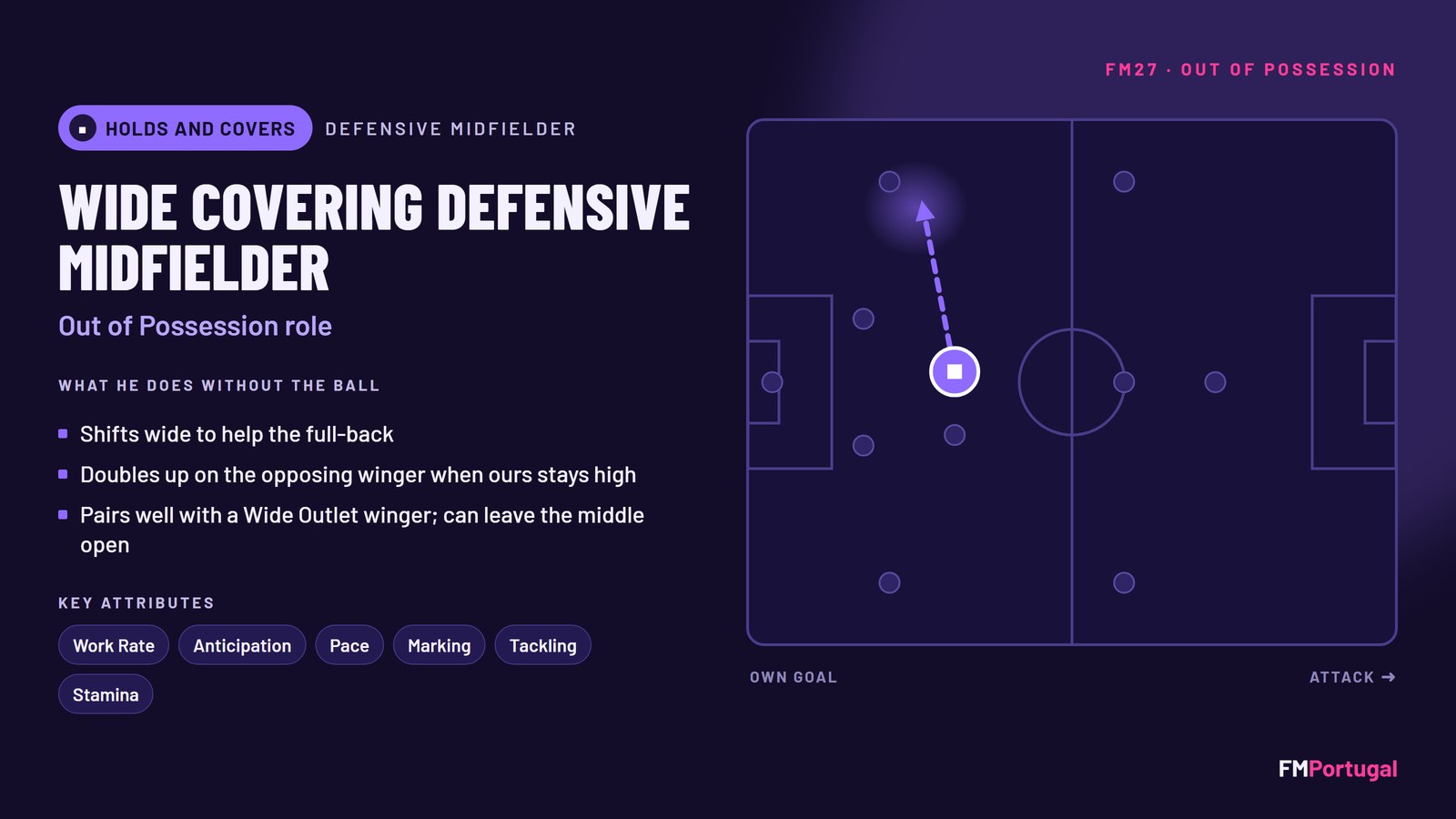
Wide Covering Defensive Midfielder: what he does without the ball (Image: FMPortugal)
When the opposition attack down his side, instead of protecting the middle he shifts wide and helps the full-back, often doubling up on the opposing winger. When the team drops very deep, however, he goes back to protecting the centre. That makes him the ideal partner for a Wide Outlet winger who stays high without defending. The risk is leaving the middle open. He needs Work Rate, Anticipation and Pace.
Central midfielders
Pressing Central Midfielder
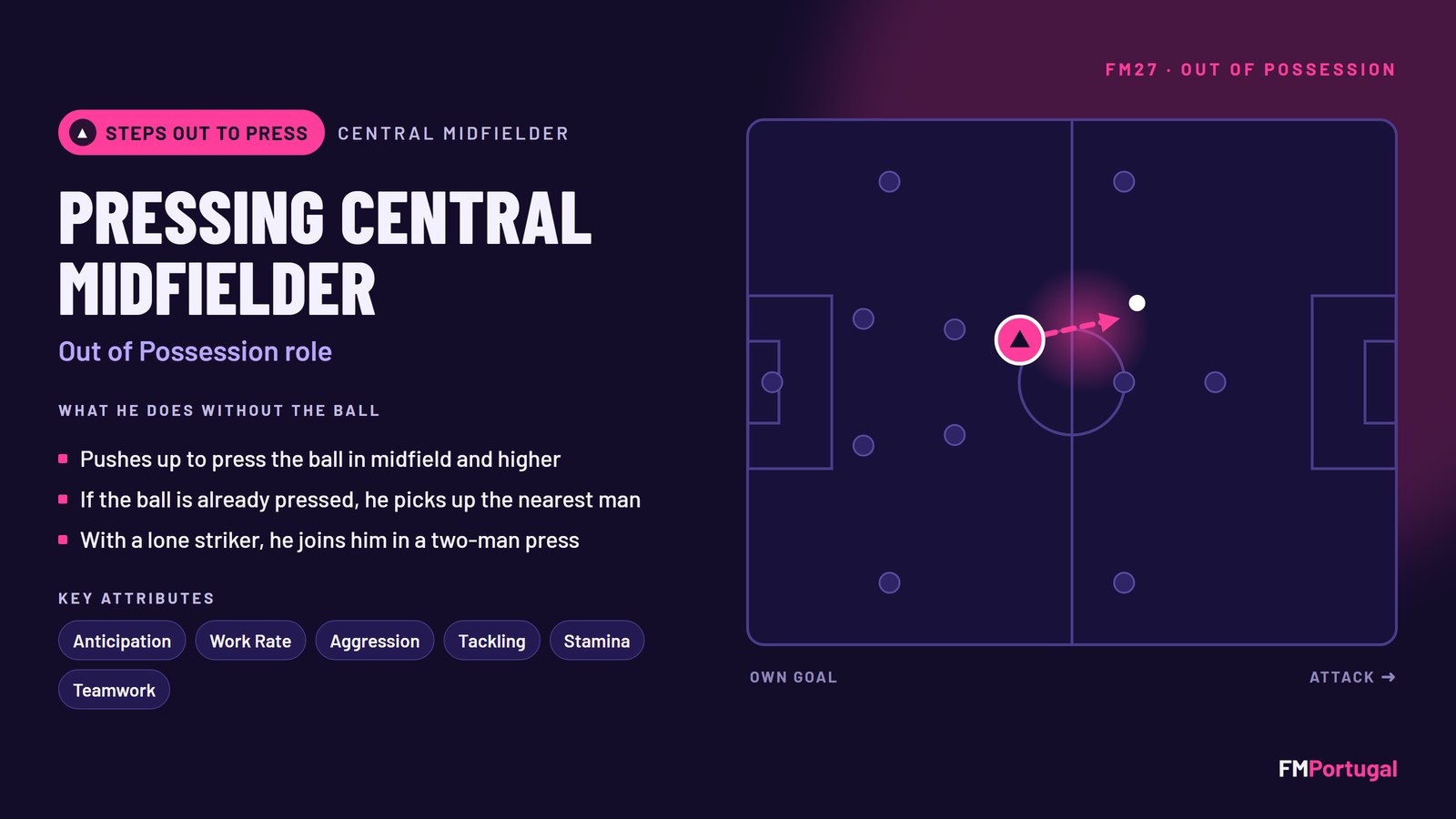
Pressing Central Midfielder: what he does without the ball (Image: FMPortugal)
He often pushes up to close down the ball in midfield and higher. If the ball carrier is already under pressure, he picks up the nearest opponent instead. In a system with a lone striker, he joins him in a two-man press; otherwise, he looks for the free player ahead of him. In his own third, he goes back to being a normal midfielder. Look for Anticipation, Work Rate and Aggression.
Screening Central Midfielder
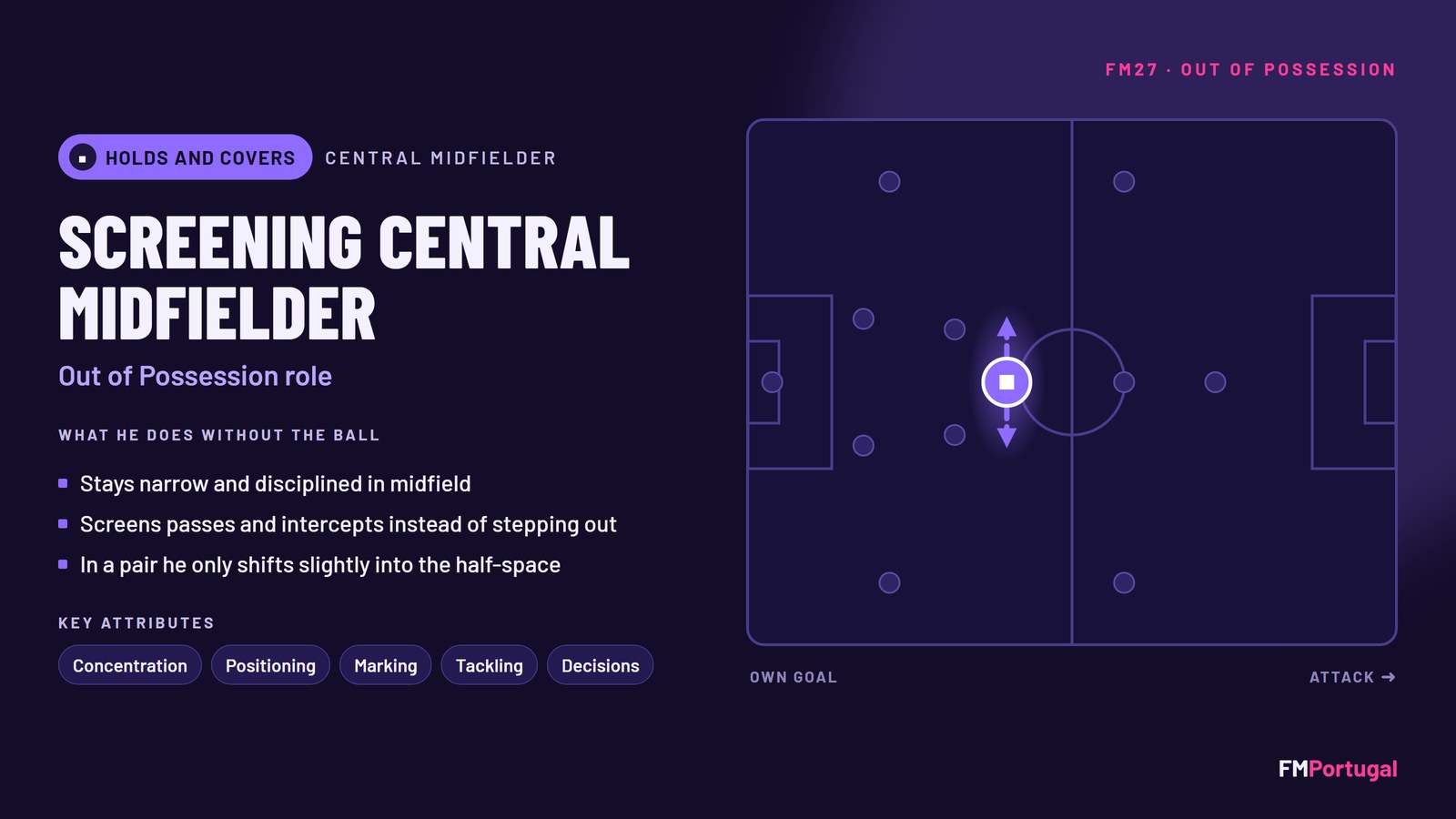
Screening Central Midfielder: what he does without the ball (Image: FMPortugal)
He stays as still and disciplined as possible, narrow in midfield. In other words, he does not get dragged out and focuses on cutting out passes through the middle. In a pair, he only shifts slightly into the half-space, without pressing. So he is a good base for a more creative midfielder next to him. Here, Concentration, Positioning and Marking count.
Wide Covering Central Midfielder
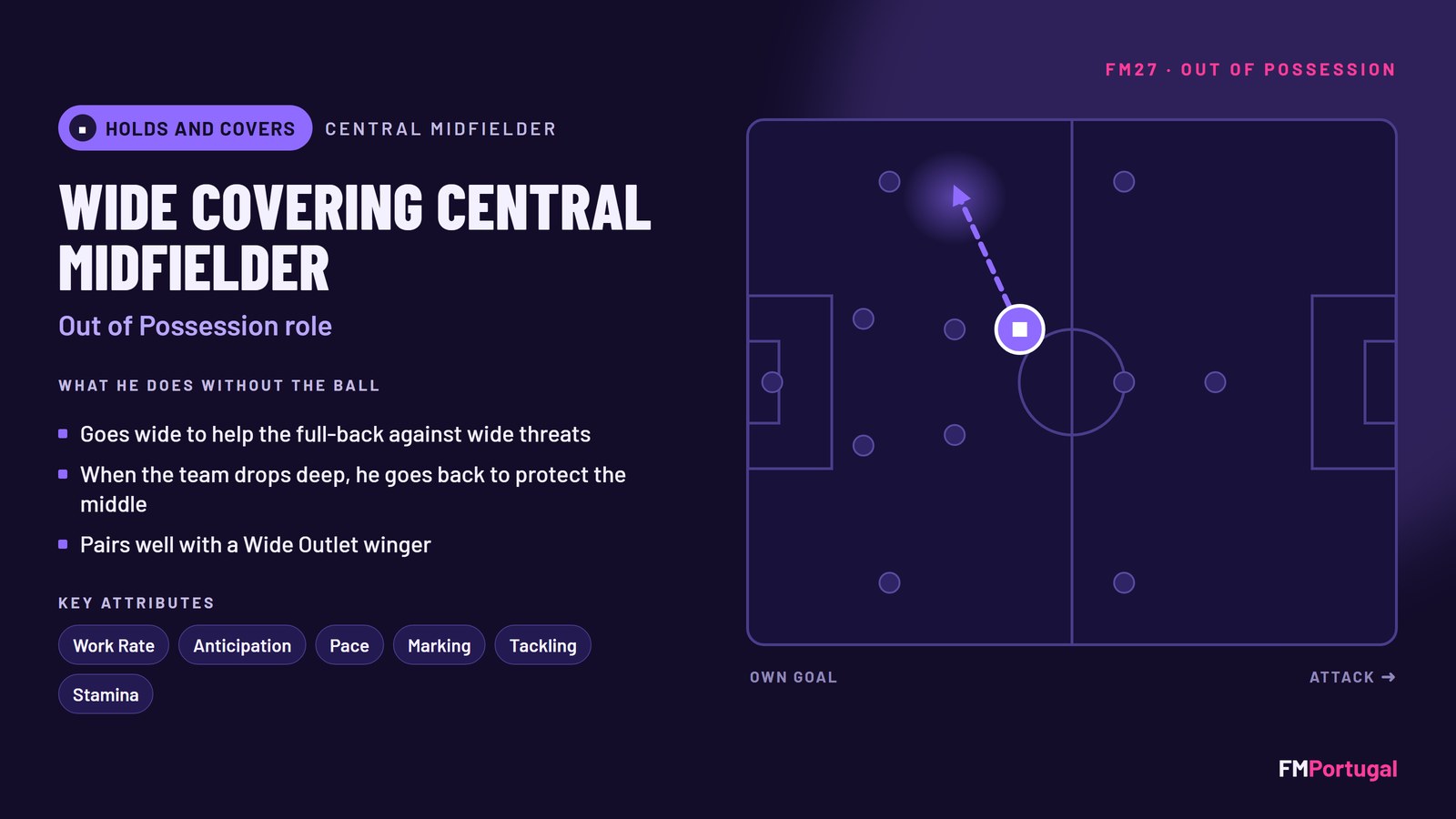
Wide Covering Central Midfielder: what he does without the ball (Image: FMPortugal)
He does the same as the wide covering defensive midfielder, but from central midfield: he goes wide to help the full-back against the opposing wide players. When the team drops very deep, he goes back to protecting the centre. So he also pairs well with a Wide Outlet winger ahead of him. He needs Work Rate, Anticipation and Pace.
Wide midfielders and wingers
Tracking Wide Midfielder
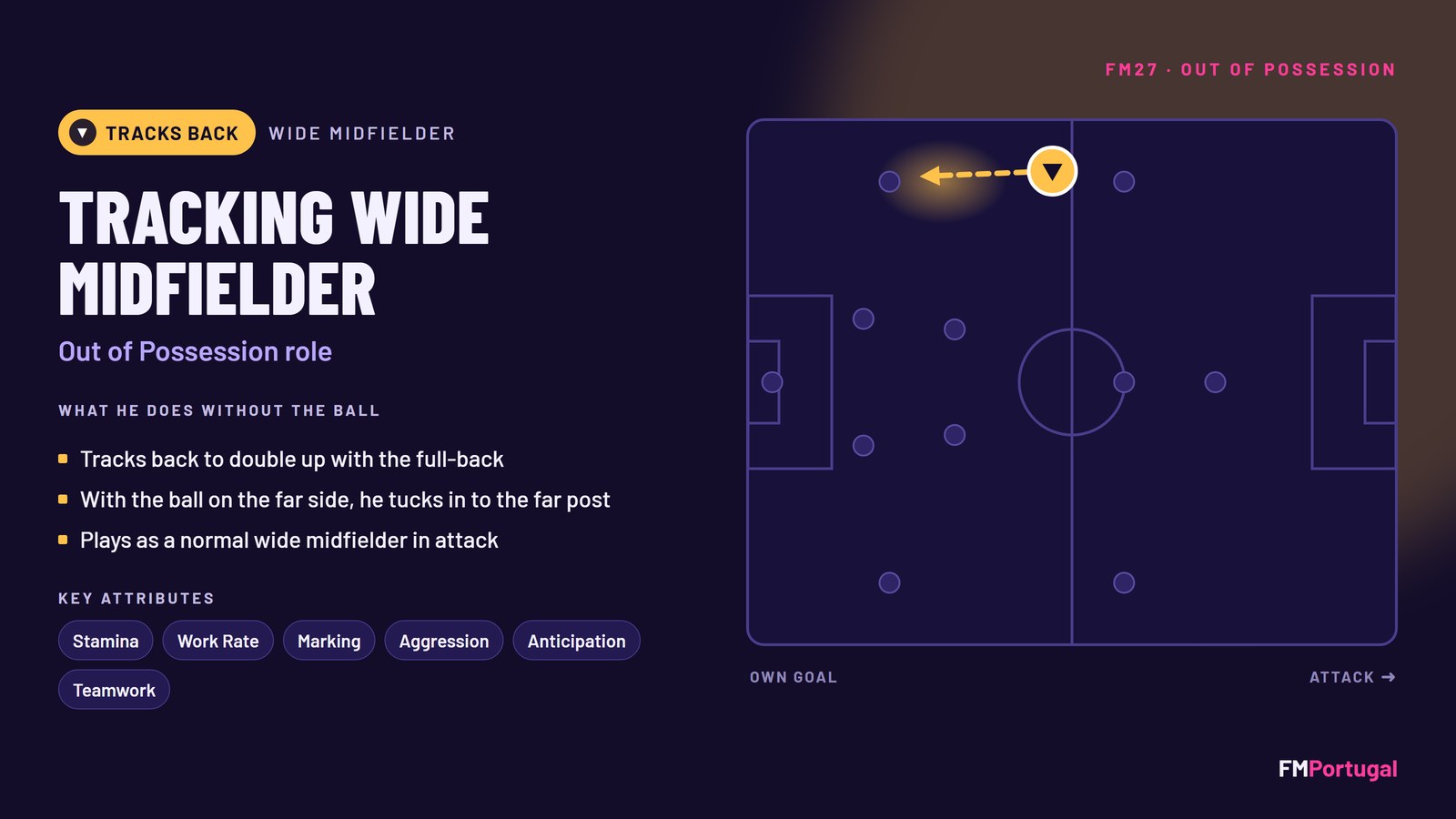
Tracking Wide Midfielder: what he does without the ball (Image: FMPortugal)
He tracks back when the opposition reach our third and sometimes even drops into the back line as an extra defender. With the ball on his side, he doubles up with the full-back; with the ball on the far side, he tucks in to defend the far post. In attack, he plays as a normal wide midfielder. Look for Stamina, Work Rate and Marking.
Wide Outlet Wide Midfielder
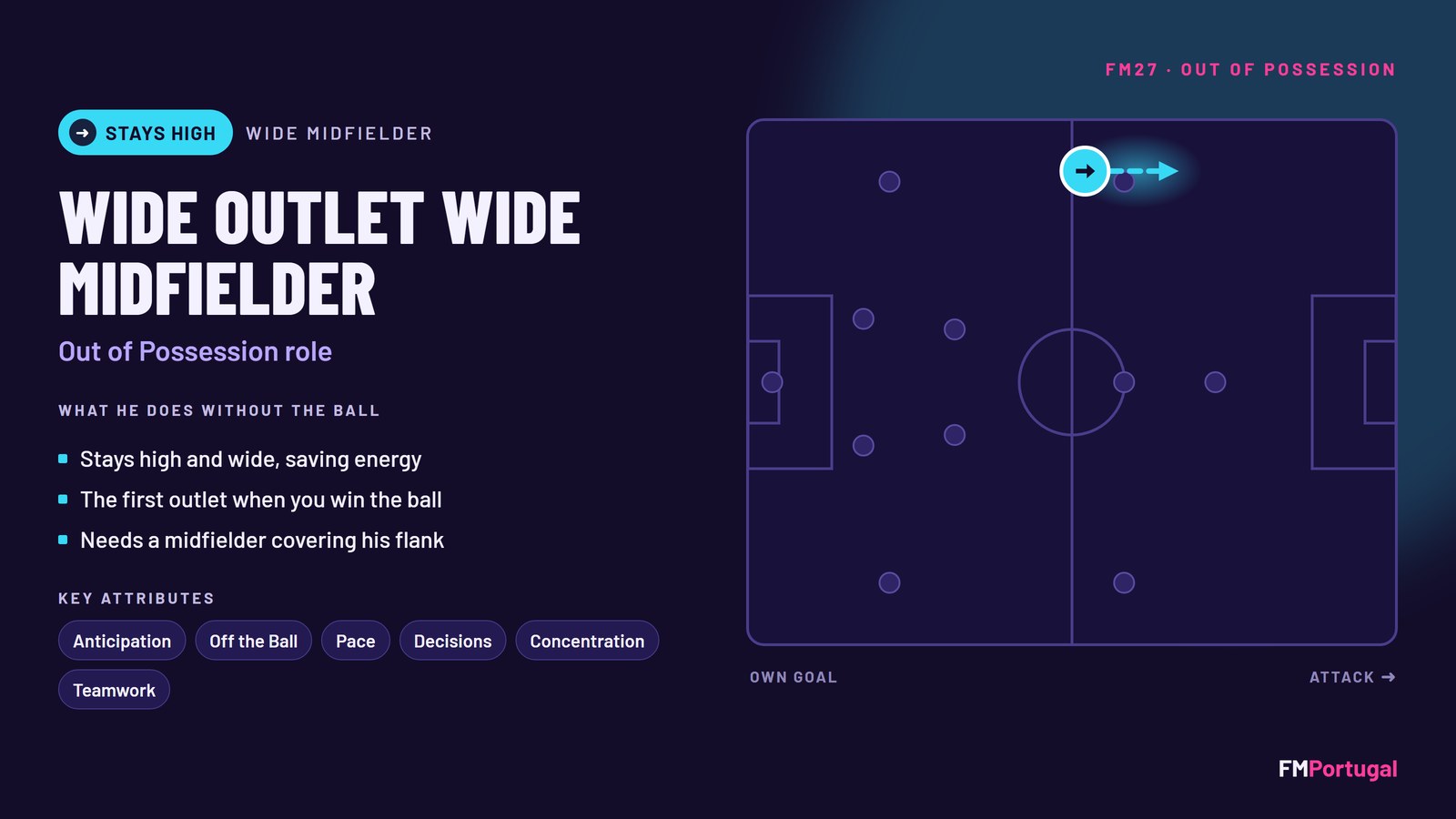
Wide Outlet Wide Midfielder: what he does without the ball (Image: FMPortugal)
He barely tracks back to help the full-back. Instead, he stays high and wide, ready for the counter when the team wins the ball. So it is wise to have a Wide Covering midfielder on that side, so the flank is not exposed. He needs Anticipation, Off the Ball and Pace.
Wide Outlet Winger
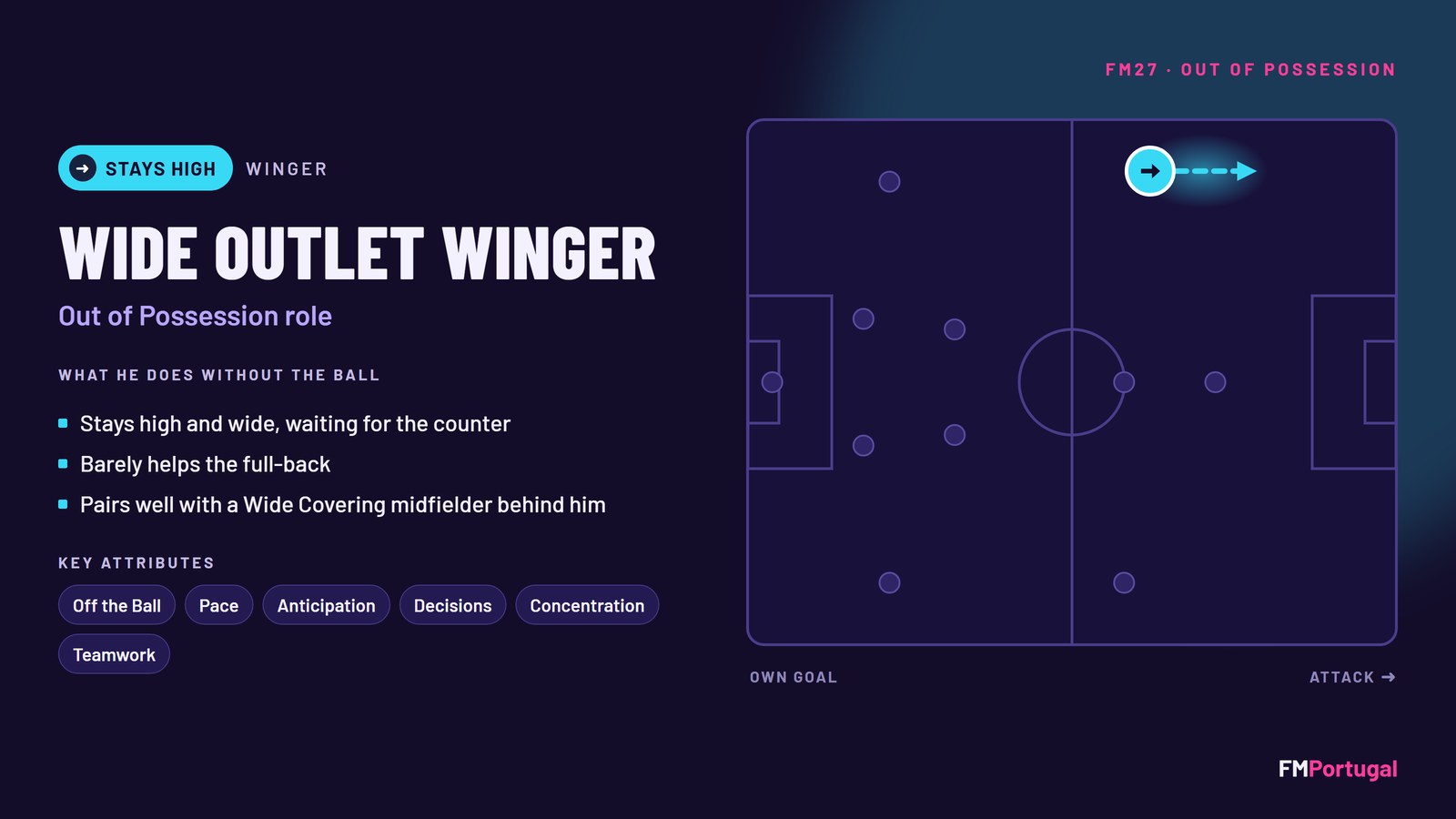
Wide Outlet Winger: what he does without the ball (Image: FMPortugal)
It is the same idea for a winger: he stays high and wide, without spending energy defending. So, when the ball changes hands, he is the first quick outlet. In the opposition half, he plays as a normal winger. His flank needs cover, however, for example from a Wide Covering midfielder. Look for Off the Ball, Pace and Anticipation.
Tracking Winger
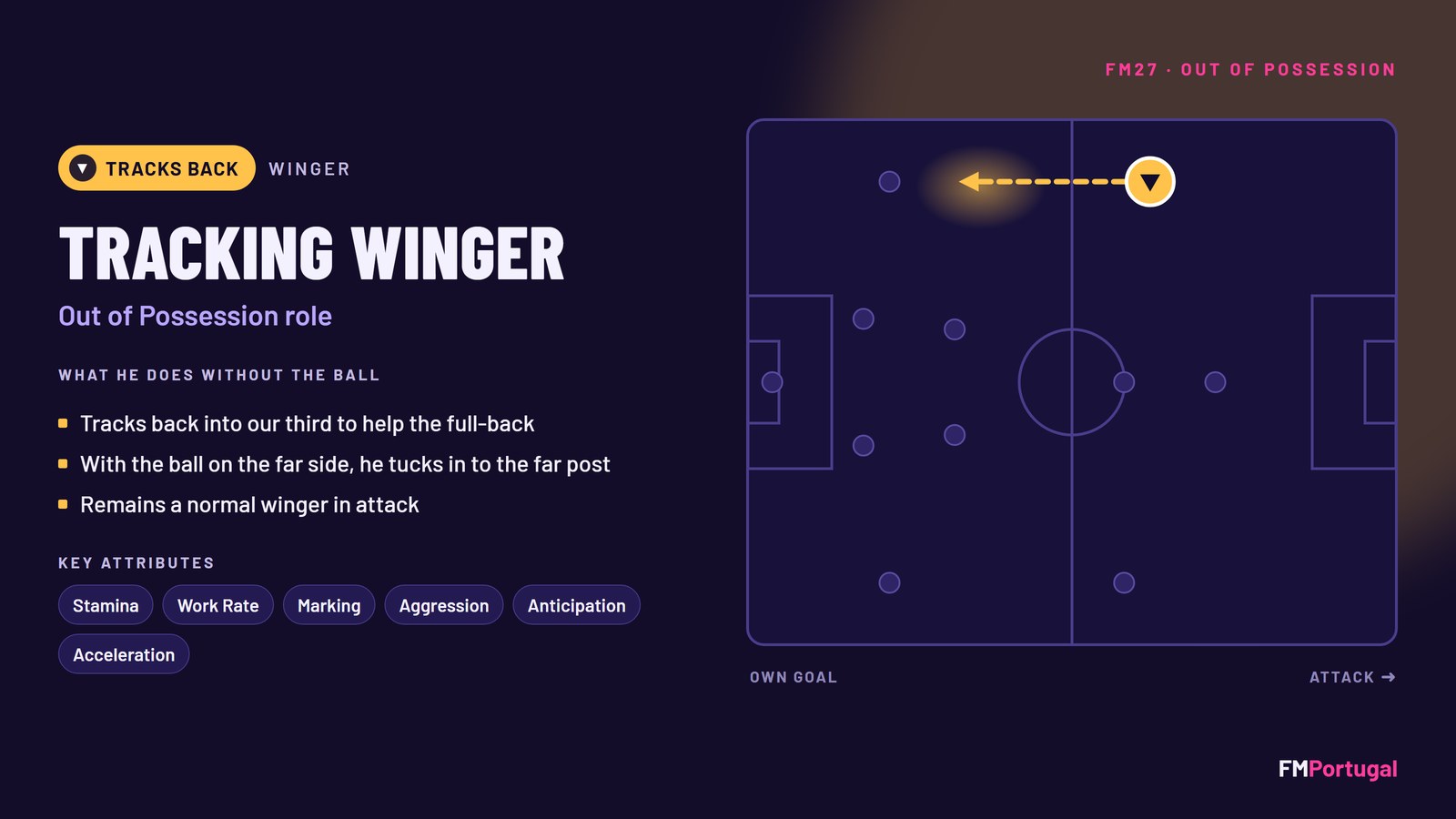
Tracking Winger: what he does without the ball (Image: FMPortugal)
He does the same as the tracking wide midfielder, but from a higher position. He tracks back into our third, doubles up with the full-back when the ball is on his side and tucks in to the far post when it is on the other. In attack, he is still a normal winger. So he is the right choice for teams that defend in a block. He needs Stamina, Work Rate and Marking.
Inside Outlet Winger
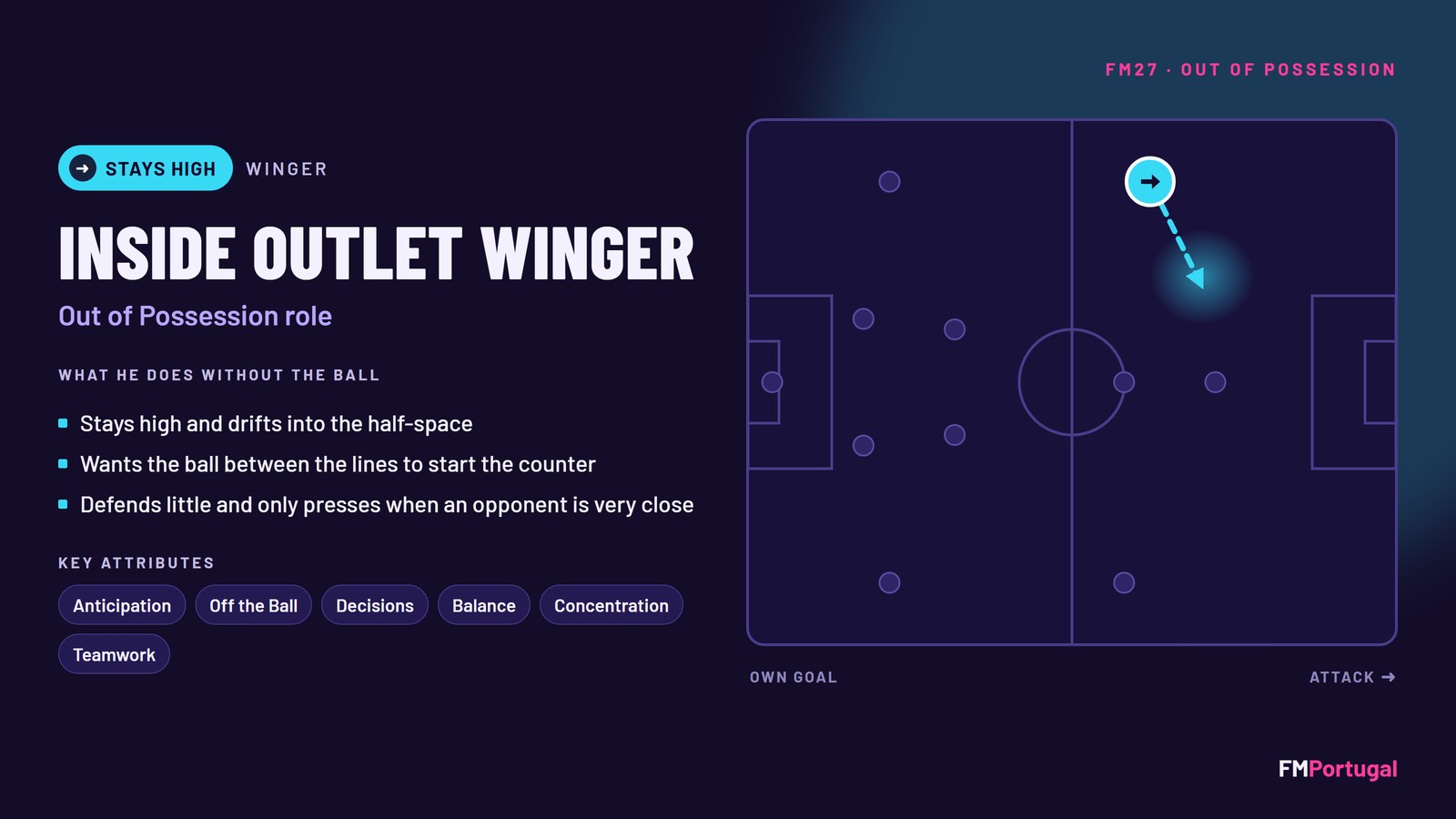
Inside Outlet Winger: what he does without the ball (Image: FMPortugal)
He also stays high for the counter, but as the opposition advance he drifts into the half-space. So he wants direct passes between the lines to start the transition through the middle. He defends little and only presses when an opponent is really close. That means his flank needs cover too. Look for Anticipation, Off the Ball and Decisions.
Attacking midfielders
Central Outlet Attacking Midfielder
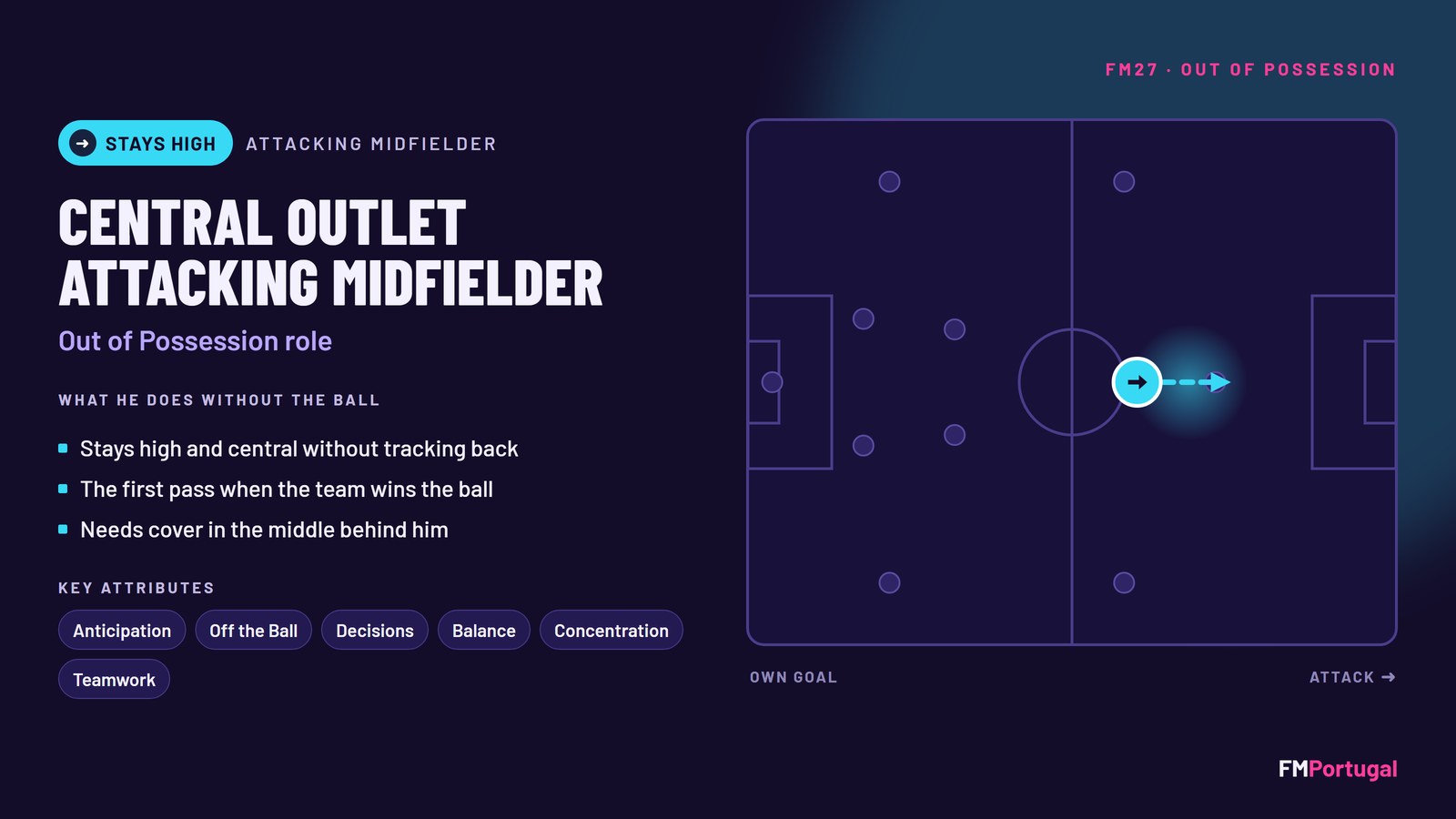
Central Outlet Attacking Midfielder: what he does without the ball (Image: FMPortugal)
He stays high and central, without dropping back to help the midfielders. In other words, he is the first pass when the team wins the ball. In some systems he sits slightly deeper, but he still does not come back to defend. So you need cover in the middle behind him. He needs Anticipation, Off the Ball and Decisions.
Splitting Outlet Attacking Midfielder
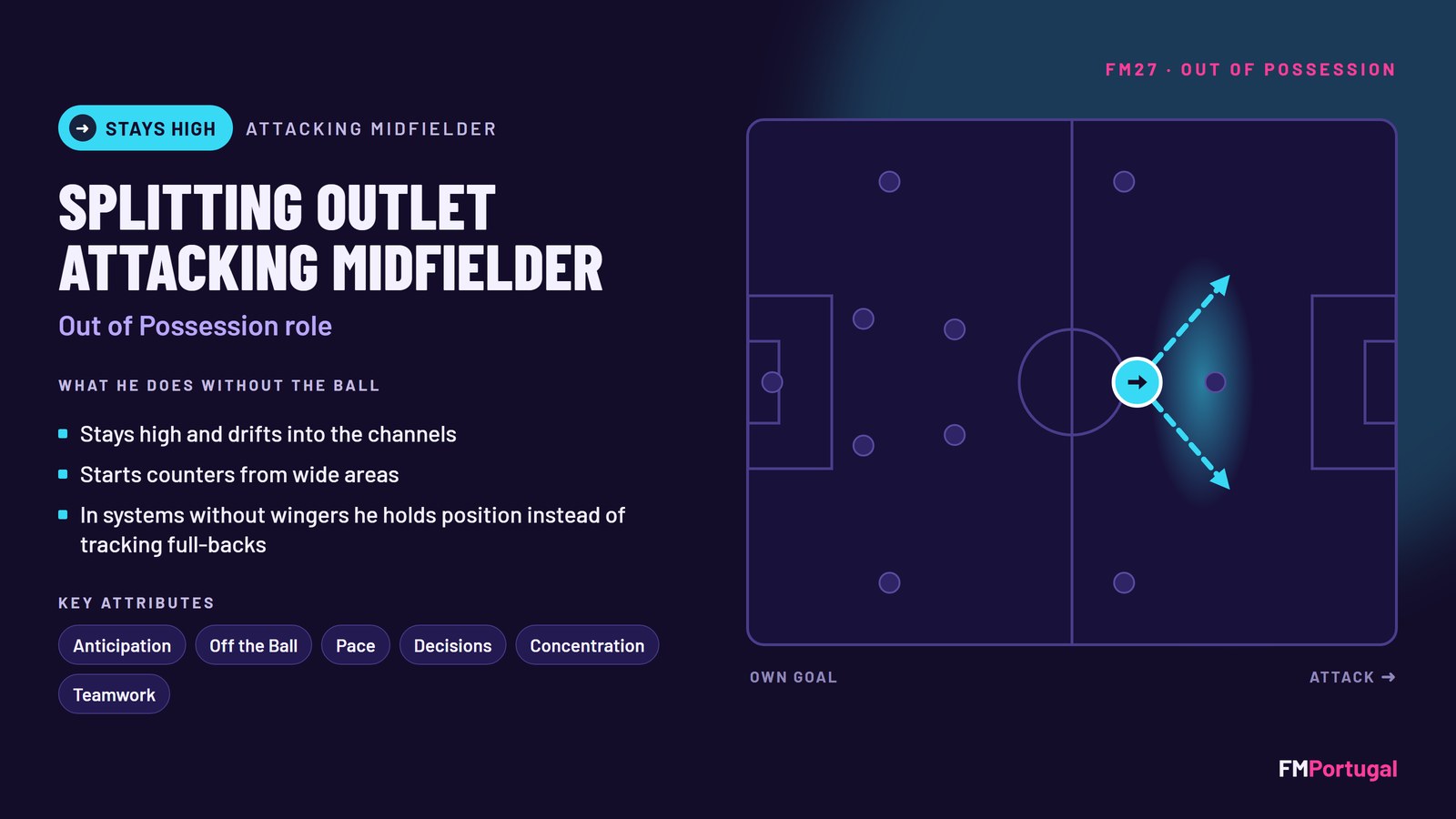
Splitting Outlet Attacking Midfielder: what he does without the ball (Image: FMPortugal)
He stays high and, as the opposition advance, drifts into the channels. So he starts counters from wide areas, where there is usually more space than in the middle. On the other hand, in systems without wide players he holds position instead of tracking the opposing full-backs. Look for Anticipation, Off the Ball and Pace.
Tracking Attacking Midfielder
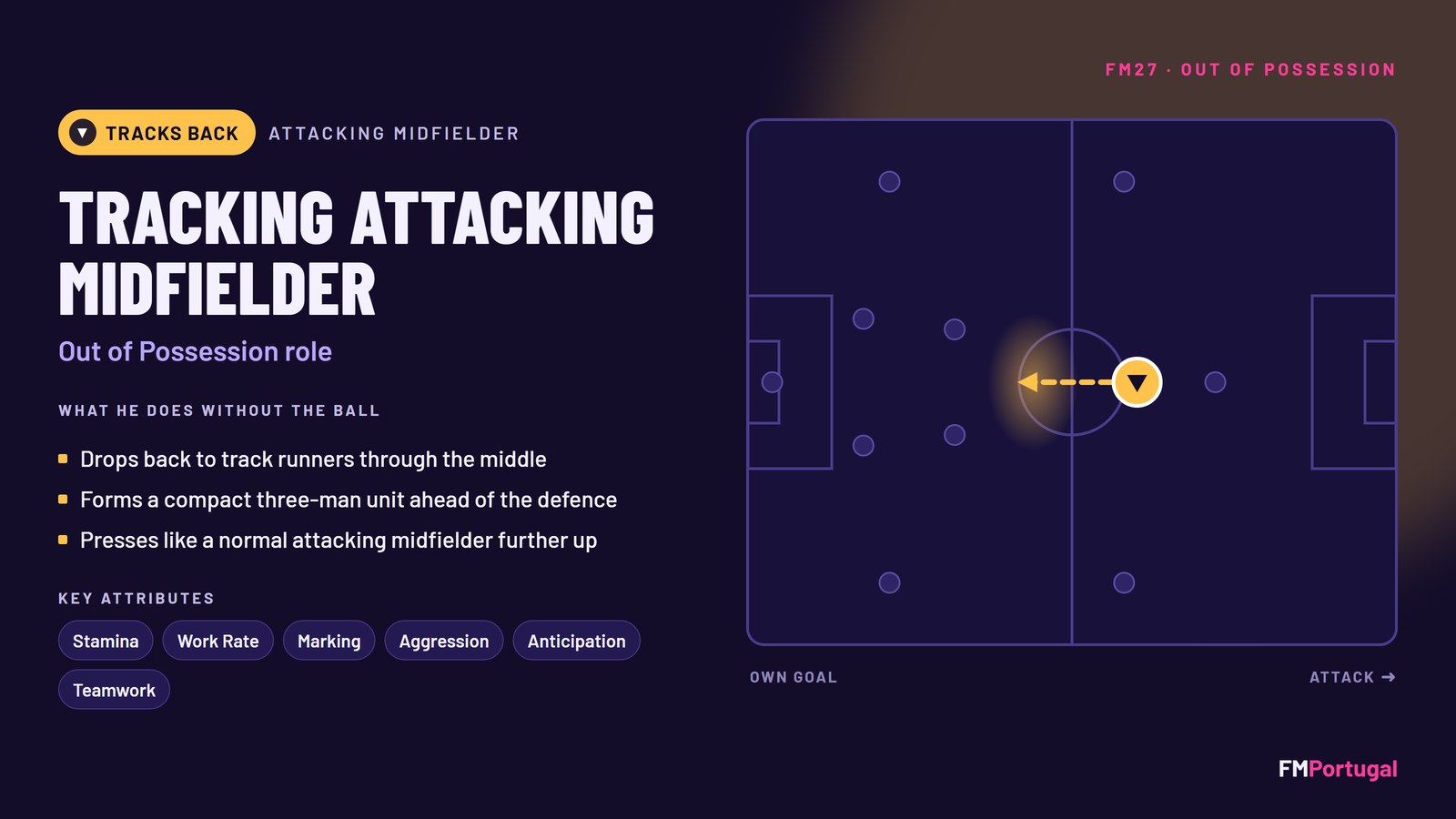
Tracking Attacking Midfielder: what he does without the ball (Image: FMPortugal)
He drops back when the opposition reach our third, to track runners through the middle. So he joins the midfielders and forms a compact three-man unit in front of the defence, with safety first. Further up, however, he presses like a normal attacking midfielder. He needs Stamina, Work Rate and Marking.
Strikers
Tracking Centre Forward
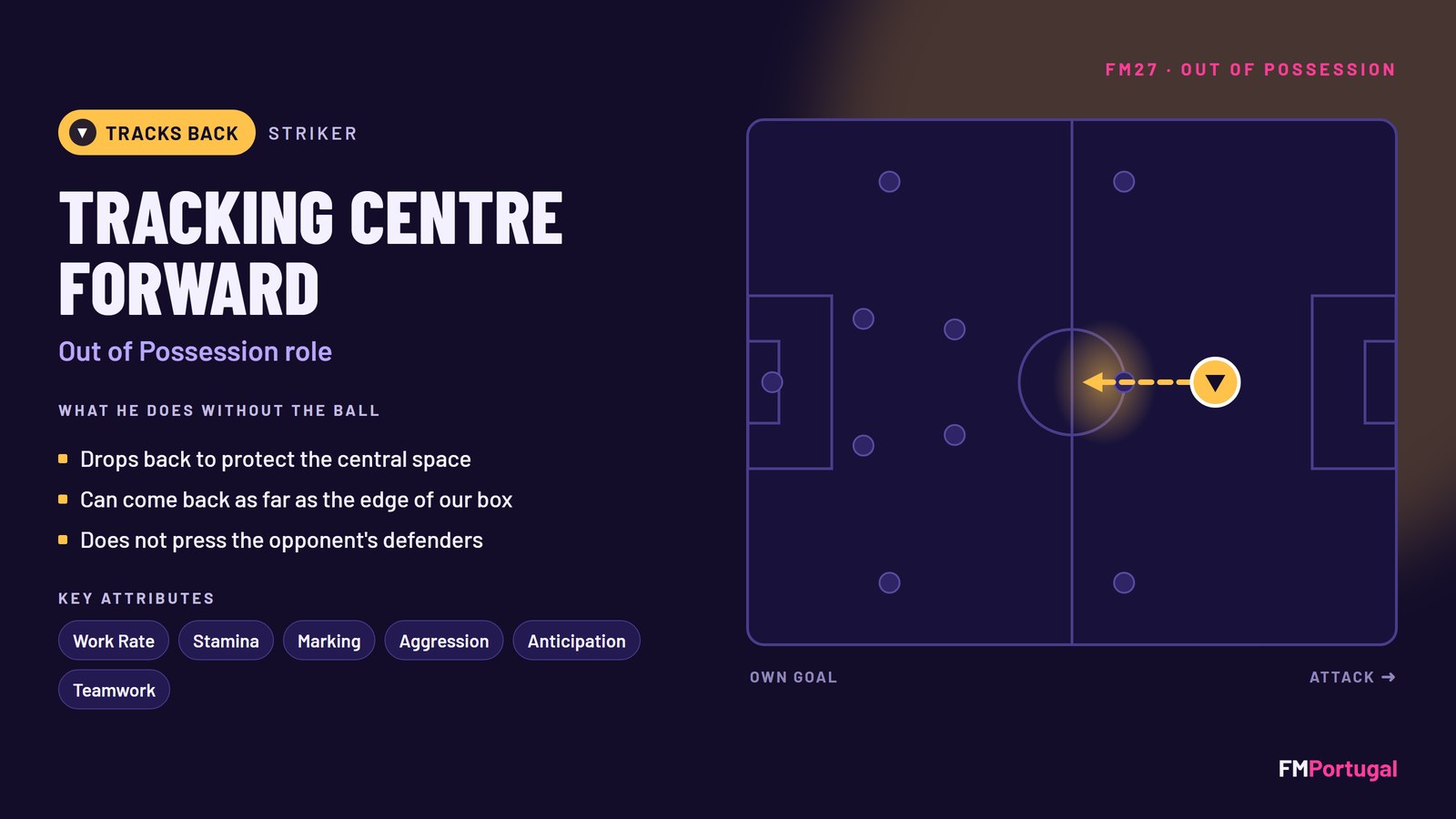
Tracking Centre Forward: what he does without the ball (Image: FMPortugal)
He drops back to protect the central space and can come back as far as the edge of our box. First he sits in the attacking midfield zone; then, if needed, he drops further. However, he does not press the opposition defenders. So he is useful for teams that defend deep and want to close the middle. Look for Work Rate, Stamina and Marking.
Central Outlet Centre Forward
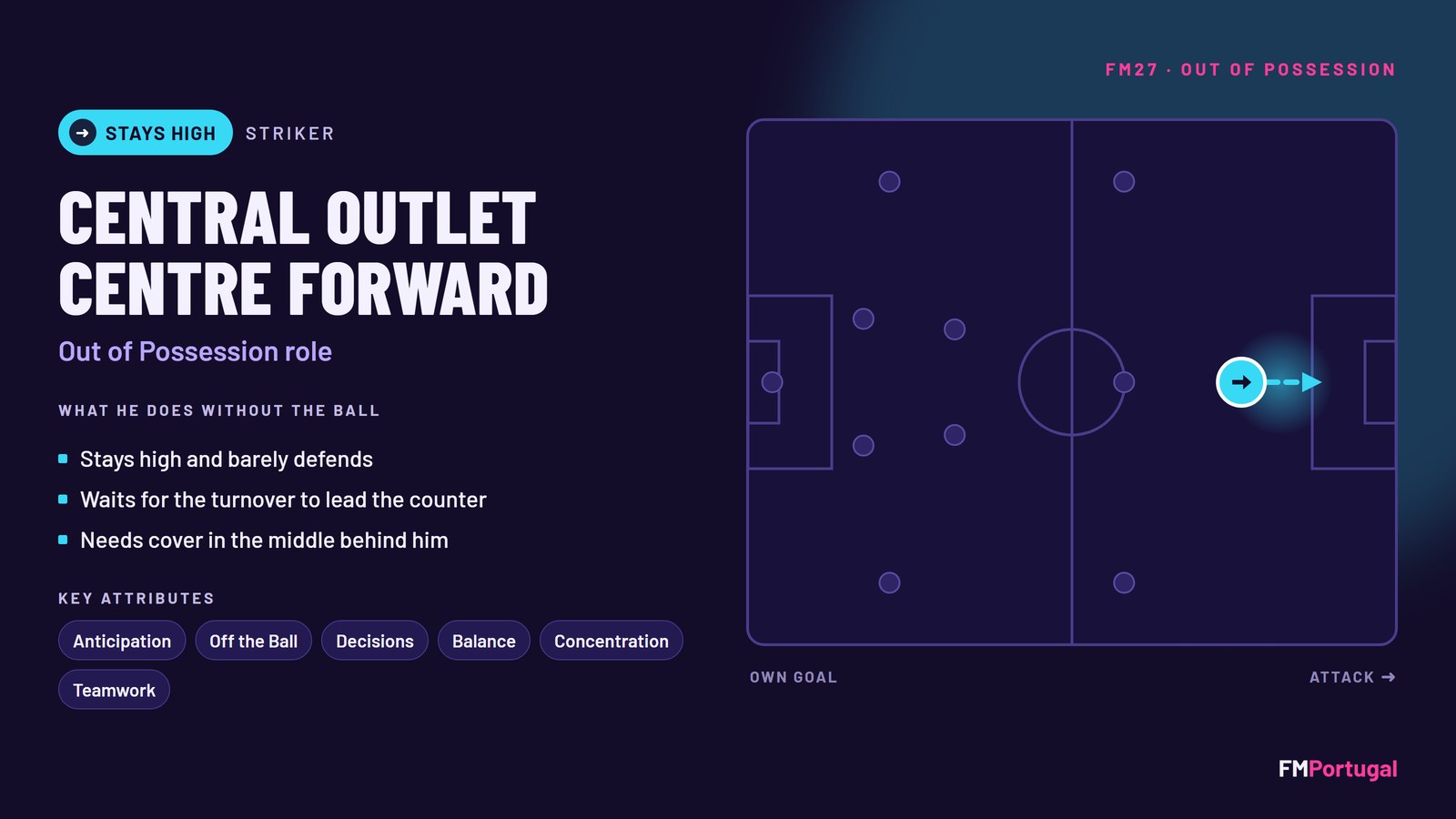
Central Outlet Centre Forward: what he does without the ball (Image: FMPortugal)
He stays high and barely defends, waiting for the turnover to lead the counter. He also does not press the opposing full-backs when the team plays without wide players. So he needs cover in the middle behind him. It is the classic role for a penalty-box striker who lives on goals. He needs Anticipation, Off the Ball and Decisions.
Splitting Outlet Centre Forward
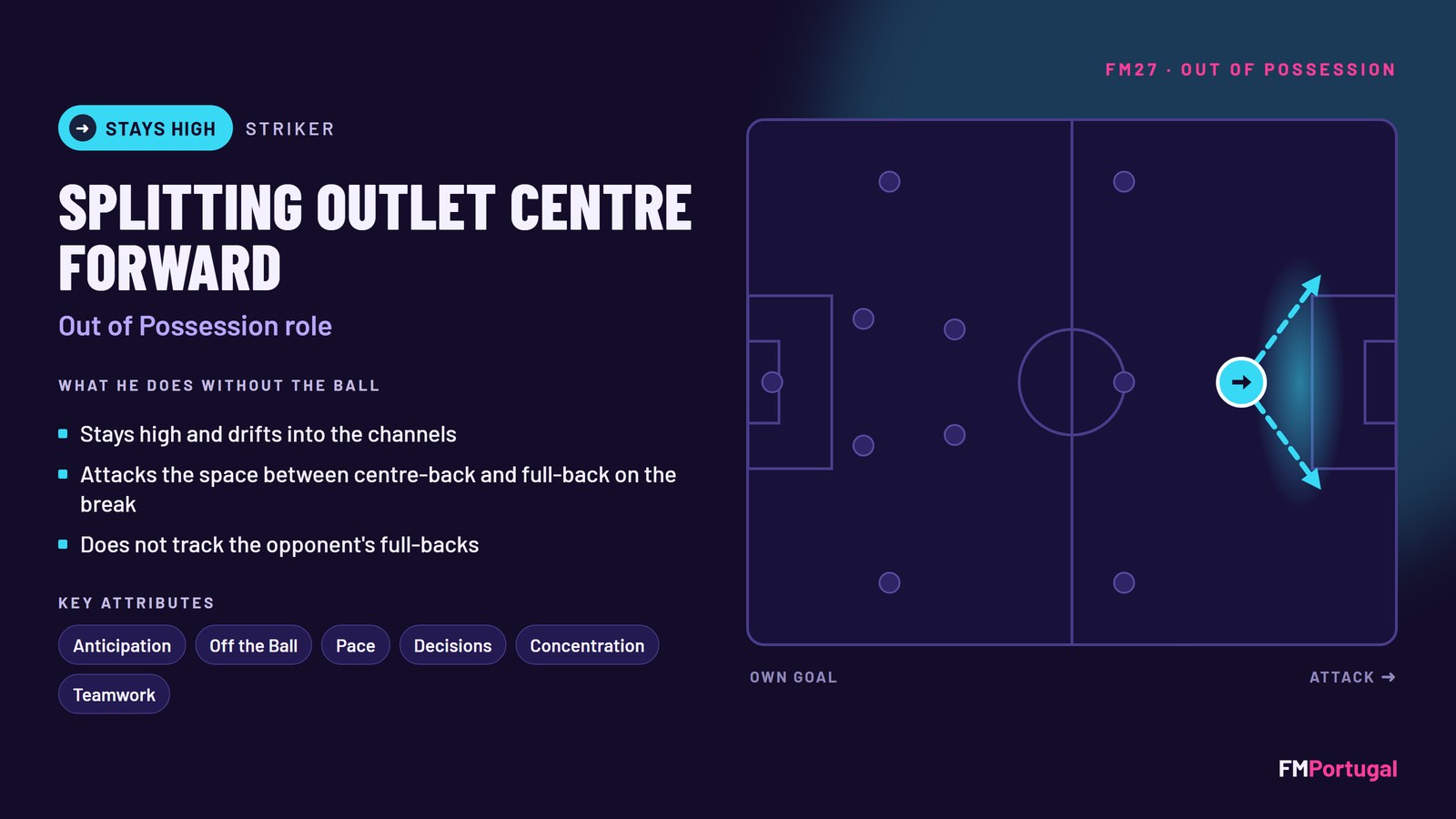
Splitting Outlet Centre Forward: what he does without the ball (Image: FMPortugal)
He stays high to threaten on the counter and, as the opposition advance, drifts into the channels. So he attacks the space between centre-back and full-back in transition. On the other hand, in systems without wide players, he holds position instead of tracking the opposing full-backs. Look for Anticipation, Off the Ball and Pace.
How to combine the roles
Balance is the key. First, pair players who step out with players who cover: a Stopping Centre-Back with a Covering Centre-Back, or a pressing full-back on one side with a holding full-back on the other. Second, every wide Outlet needs someone covering that flank, for example a Wide Covering midfielder. Finally, if your full-backs push high with the ball, a Dropping Defensive Midfielder closes up the back line when you lose it.
It is also worth thinking about Tactical Effectiveness. After all, roles that ask for attributes your squad lacks lower your players’ ability to carry out the tactic. If you want help with that, read our guide on how to improve Tactical Effectiveness in FM27. In addition, FM27 Tactic Builder suggests an in possession and an out of possession role for every player in your squad.
Our take
Splitting play with the ball from play without it was the best tactical change in years, and FM27 was right to keep it. As a result, you no longer have to choose between a winger who attacks well and one who defends well. However, the names are similar and confusing at first. So the four-idea rule (press, hold, track back, stay high) is the best place to start. Then, if you want to see it all in action, take a look at Knap’s FM27 tactics.
Sources
- In Possession, Out of Possession: FM26’s New Tactical Evolution (footballmanager.com, Sports Interactive)