Setting up your FM27 training is no longer about picking any schedule and forgetting about it. With Tactical Effectiveness, every new session takes the place of another. On top of that, there are tests showing those choices are worth points by the end of the season. So we gathered what ZaZ, harvestgreen22, caiograco, jamiebolden and DrLaser found in November, all of it in FM27.
We won’t repeat what Tactical Effectiveness is, because that’s covered in our guide to improving Tactical Effectiveness. Here the focus is the week: when to train, when to rest, how many tactical sessions are enough and why. Along the way you get two example calendars, one for weeks with one match and one for weeks with two.
The logic of FM27 training: rest to perform
It all starts with ZaZ’s training schedules (Training Schedules), published on 10 November and refined until 26 November. In other words, the idea is simple. On the day after a match, the squad gets full rest, to trigger the so-called super rest. The other training is packed into a few days, and the remaining days are rest too.
Why so much rest in FM27 training? First, because training injuries are only rolled on days with training. So a day off is a day with no roll. Besides, ZaZ cites tests showing fewer injuries when the same sessions are grouped into fewer days. For example, another tester went through FM27’s training code and jamiebolden shared the results: across 5,888 runs of a 36-day test, grouping the same sessions into fewer days cut injury risk from 13.8% to 4.0%, with almost the same development.
However, there is a price. Each day without training costs 0.5% of Match Sharpness, except the day after the match. In other words, a midweek day off costs little, and ZaZ thinks it pays off.
For intensity, the rule is Double Intensity only for players in good or excellent condition. Below that, no pitch or gym work. In FM26, ZaZ only used double intensity with excellent condition. However, the training load in FM27 is much lower, so there is now room to train hard without much risk.
FM27 training: an example weekly plan
We turned the rules above into two FM27 training calendars. They are our own examples, built with ZaZ’s rules, and not the original files.
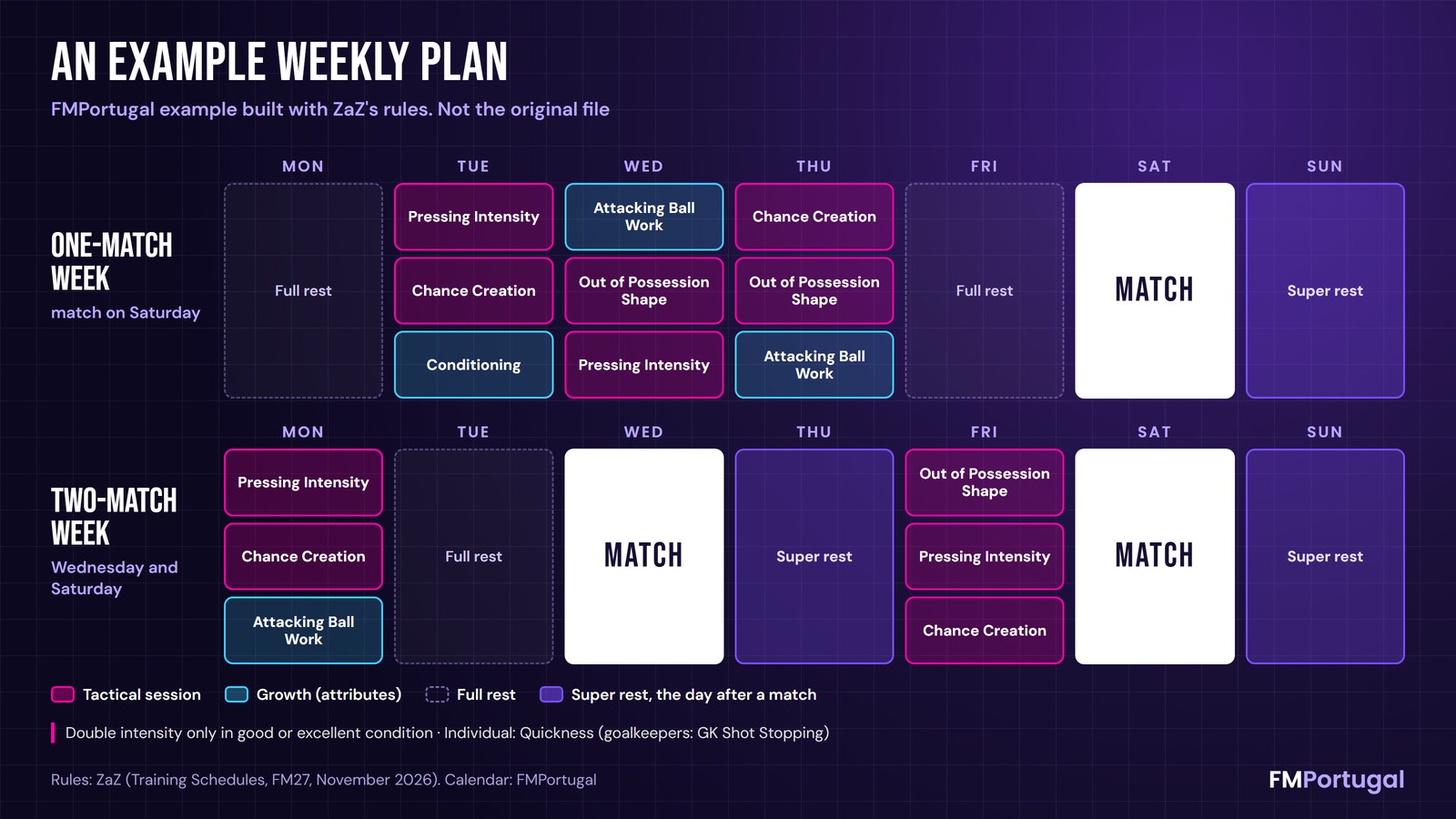
Two example weekly plans, with the rest rules and the tactical areas that matter (Image: FMPortugal, with data from ZaZ)
In a week with one match on Saturday, Sunday is the super rest and Monday is also a day off. Then Tuesday, Wednesday and Thursday are the full days. That’s where six tactical sessions go in, two for each of the three main areas. Three growth sessions go in too: two of Attacking Ball Work and one of Conditioning. Finally, Friday is full rest and Saturday is match day.
With two matches, Wednesday and Saturday, the maths changes. ZaZ leaves no doubt: in those weeks rest matters more than training, especially with a thin squad. So you are left with two training days, Monday and Friday, with six sessions in total. Even so, the matches help, because each match gives exposure to the tactic, which is another part of the tactical areas.
The original plan goes further: according to ZaZ, it reaches 100% in the three most important areas and around 57% in a fourth. If you don’t feel like building anything, the FM27 training schedules we published come with ready-made weeks.
How many tactical sessions you need
This is the part of FM27 training that shakes up the calendar the most. According to ZaZ, Training Contribution and match exposure lose 38 points a day, up to a maximum of 10,000. So each area needs eight sessions a month to reach and stay at 100%. With six sessions you are close to 85%, with four at 57%, with three at 42% and with two at 28%.
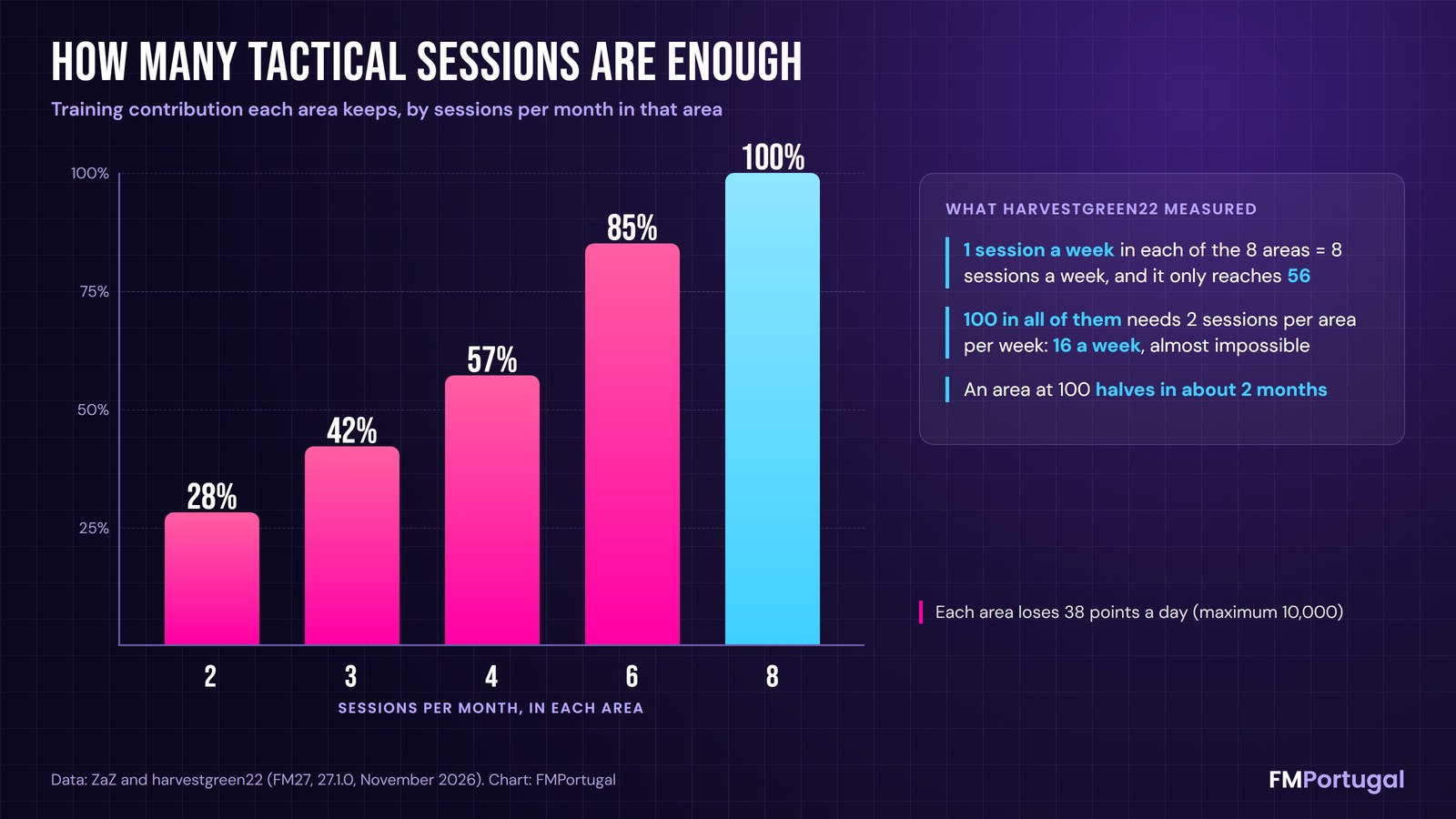
How much training contribution each area keeps, by sessions per month (Image: FMPortugal, with data from ZaZ and harvestgreen22)
harvestgreen22 reached the same conclusion another way. One session a week in each of the eight areas already means eight sessions a week, and even then it only reaches 56. To get to 100, each area needs two sessions a week, that is, 16 sessions. In a real save, that is almost impossible.
What if you get one area to 100 and then move on to another? That doesn’t work either, because the value halves in about two months. Even if you keep one session a week, it falls back to 56. Also, according to harvestgreen22, the result held after the 27.1.0 update. In short, FM27 training can’t cover everything, and you have to choose.
Which tactical areas to train (and which to leave to matches)
This is where caiograco comes in, running the FM27 match engine outside the game with the Fm-Match-Lab project. Of the eight areas, only two really matter: Chance Creation and Pressing Intensity. Then comes Out of Possession Shape, with about half the weight. The other five barely move results.
The table uses the figures ZaZ published for gegenpress tactics. They are points per season, against an area at 45.
| Area value | 8 | 25 | 37 | 45 | 58 | 73 | 85 | 95 |
|---|---|---|---|---|---|---|---|---|
| Chance Creation | −3.8 | −3.8 | −2.8 | 0 | +1.7 | +2.2 | +2.9 | +3.0 |
| Pressing Intensity | −3.6 | −3.0 | −2.5 | 0 | +2.2 | +2.8 | +3.1 | +3.9 |
| Out of Possession Shape | −1.9 | −1.3 | −1.0 | 0 | +0.5 | +1.0 | +1.6 | +1.5 |
| Build-up | −0.7 | +0.1 | −0.3 | 0 | +0.8 | +1.2 | +1.2 | +1.4 |
The other four areas never go past one point, up or down. That’s why ZaZ left them out on purpose: every extra session takes growth away from the important attributes and brings more injuries.
caiograco also leaves two warnings. First, the effect works in bands (16, 34, 41, 51, 67, 81 and 91). For example, going from 48 to 52 counts, but 70 to 78 changes nothing. Then, look at each player and not the team average, because new signings and players in a new position tend to be the low ones. So the goal is to have every starter above 50 in the two main areas.
How much is this worth? For caiograco, getting the two main areas right is worth 3 to 6 points a season. That can decide a title, but signing good players is still worth more.
Attributes and why Attacking Ball Work is in FM27 training
In the growth sessions of FM27 training, ZaZ targets the attributes that matter most: Pace, Acceleration and Stamina, followed by Anticipation, Strength and Jumping Reach. We explained the value of each one in the most important attributes in FM27. For individual training, the pick is Quickness for outfield players and GK Shot Stopping for goalkeepers.
So why does the plan use Attacking Ball Work, if it doesn’t train those physical attributes? ZaZ explains that there is a cap on how much each attribute rises and another on the CA gained each week or month. So two or three weekly sessions with double intensity and Quickness already hit that cap. Everything else only redirects growth to other attributes.
If you only train the physical side, technical and mental attributes keep dropping and the player never reaches their PA. Attacking Ball Work prevents that, trains Anticipation and also raises transfer value. To see your players’ real PA, FMPT Chief Analyst shows it for free.
There are three more notes. First, version 1.1 dropped Light Conditioning, because harvestgreen22’s tests showed the plan was better without it. Then, Team Bonding matters little and takes growth away from attributes. Finally, individual position training is only useful for learning a new position. In that case the role doesn’t matter, so pick one that pushes Pace and Acceleration.
Want more technical players? Then ZaZ suggests adding individual sessions and removing the Conditioning ones, but you lose Pace, Stamina and Jumping Reach.
Don’t hand training to your assistant
jamiebolden, who maintains the fm-scoring repository, tested four ways of setting up FM27 training over a Bradford season in the Premier League. They also ran each setup three times and left the test schedules in the repository.
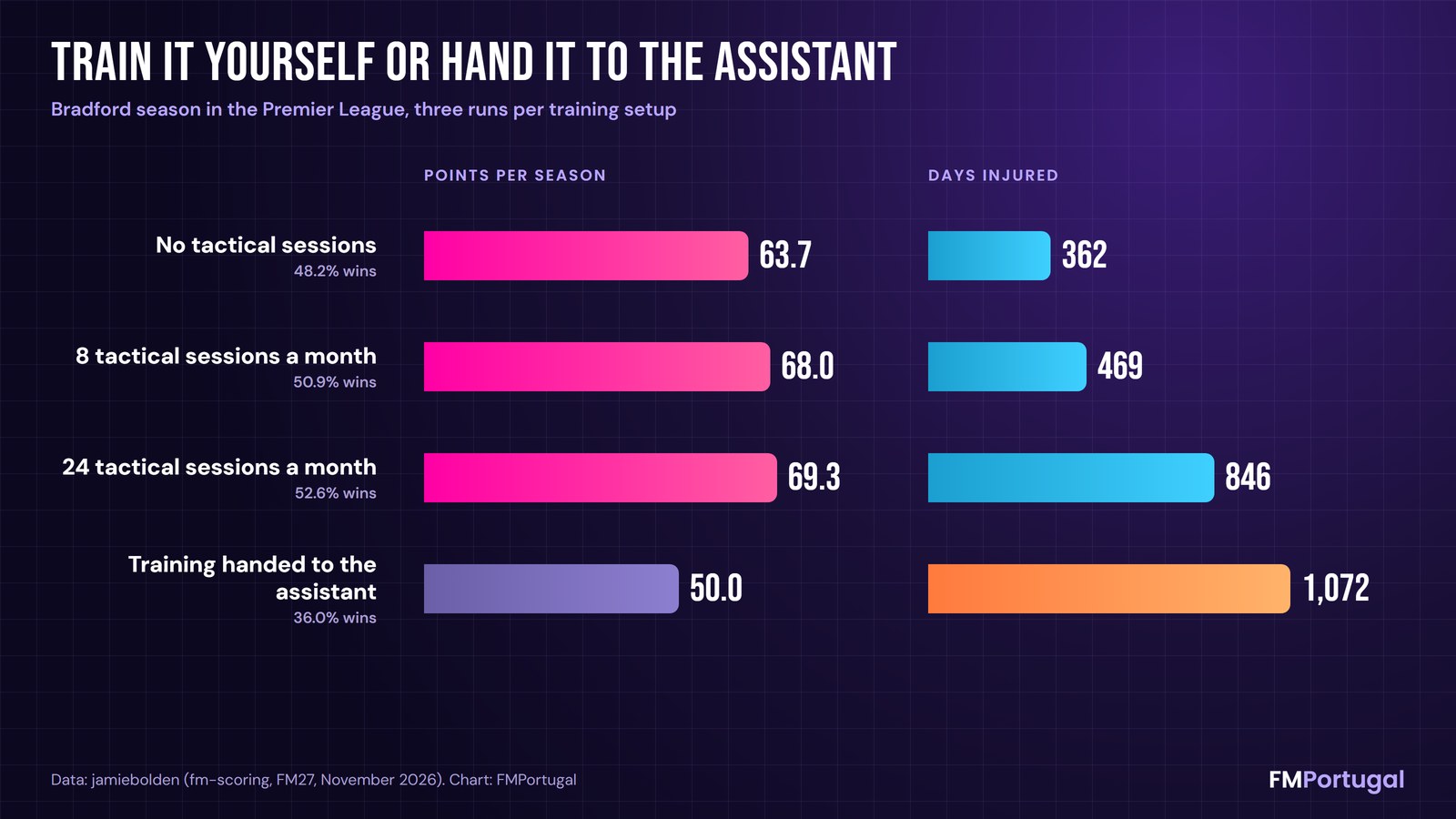
Points per season and days injured for each training setup, in the Bradford season (Image: FMPortugal, with data from jamiebolden)
With no tactical sessions, the team got 63.7 points. With eight tactical sessions a month it rose to 68.0, and with 24 a month it reached 69.3. However, look at the injuries: from 469 to 846 days injured between those two plans. In other words, tripling the sessions only added 1.3 points and almost doubled the time out.
The worst case was handing training to the assistant. The team finished on 50.0 points, won only 36% of its matches and racked up 1,072 days injured, three times the plan with no tactical sessions. Still, it is one test with one club and one tactic, so read it as a direction and not as an exact rule. In fact, across the three runs of each plan, every setup except the assistant’s won the league once, which shows how much luck in FM27 weighs.
In the end, jamiebolden settled on a simple rule. First, the youth team trains with no tactical sessions, because that way they gain more Pace and Acceleration. Then, with a thin squad or a crowded fixture list, eight tactical sessions a month are enough. Finally, at a club with a big squad and money to rotate, it is worth going up to 24 a month, even with more injuries.
27.1.0, semi-pro clubs and youth teams
On 17 November, the 27.1.0 update brought an annoying change to FM27 training. Picture a plan with a match day followed by full rest. If there is no match that week, FM27 swaps those days for individual training sessions. On the other hand, with two full rest days, it adds a recovery session after the match.
That’s why ZaZ made version 1.2 with four identical files, only with the matches on different days. There is one for weeks with no matches and one for a Wednesday match, which also works for Tuesday. Then there is one for Saturday (works for Friday) and one for Wednesday and Saturday. So you pick each week’s file according to the fixtures. As Cimbom suggested, at the end of the season you can copy the no-match version to every week, before the new fixtures come out.
At semi-pro clubs, the normal schedules won’t load. DrLaser found the fix: in the new schedule screen, you load one of the game’s own part-time schedules, change it and save it. The schedule stays part-time and works at those clubs. That’s how DrLaser rebuilt ZaZ’s schedules, with no data, just a feeling that they work. For that level, ZaZ suggests Conditioning, Attacking Ball Work and four tactical sessions, cycling between two schedules. However, ZaZ also warns that, with low PA and poor facilities, it is not worth spending much time on it.
For youth teams, nobody has tested anything yet and the sessions aren’t even the same. So ZaZ brings the most promising players to train with the first team, while they play for the youth side. Match Preparation was also left untested in FM27 training.
What comes next
If you’d rather download ready-made plans, see the FM27 training schedules we have gathered. To understand where the tactical areas come from, read how the FM27 match engine works. Finally, if you are still looking for a simple tactic to train, see the best FM27 tactics.
Our opinion
What surprised us most was the idea that less is more. More days off and only two or three tactical areas sound like too little, but the numbers back them up. We were also struck by the cost of handing everything to the assistant. On the other hand, 27.1.0 complicated something that was simple, and choosing between four files is a chore. Even so, it is worth spending ten minutes on your FM27 training every week. Have you tried these plans in your save? Tell us on the FMPortugal Discord.
Sources
- ZaZ: Training Schedules, versions 1.0 to 1.2 (FM27, 10 to 26 November 2026).
- harvestgreen22: training contribution tests on 27.1.0 (19 November 2026) and the training spreadsheet kept in jamiebolden’s repository.
- caiograco: FM27 match engine studies on the tactical areas (16 November 2026), made with Fm-Match-Lab.
- jamiebolden: Bradford training test and test schedules in fm-scoring.
- DrLaser: part-time schedules for semi-pro clubs (12 November 2026).