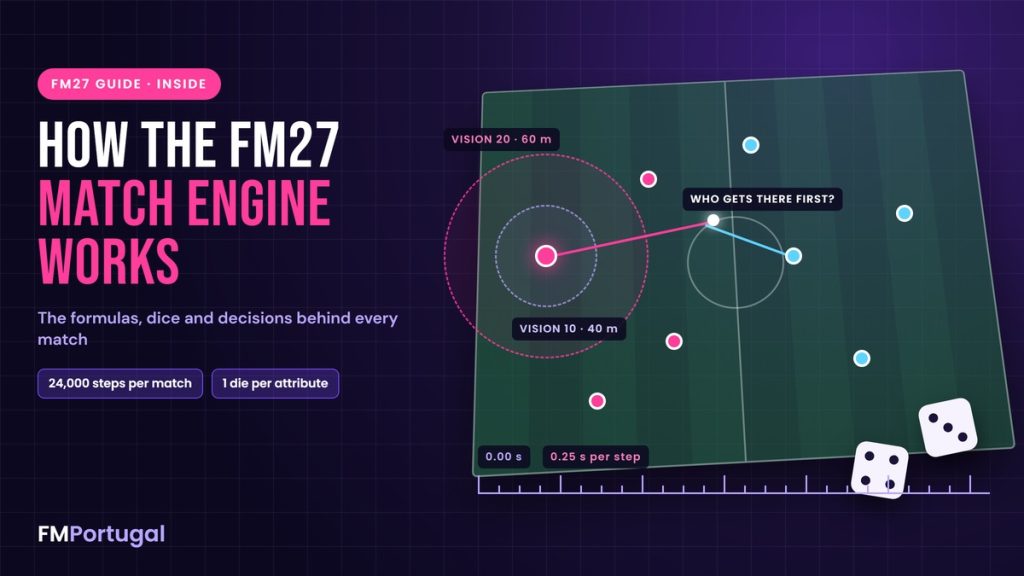
Why is Pace worth so much in FM27 and Passing almost nothing? Our guide to the most important attributes in FM27 showed how much each attribute is worth. Now caiograco, the same player who measured those values, went into the code of the FM27 match engine to explain why. With the help of an artificial intelligence agent, they saw which parts of the engine read each attribute, how often and when, and pulled out the formulas. We gathered the essentials here, with our own charts.
In short:
- The FM27 match engine moves in 0.25-second steps, about 24,000 per match, and spends 70% of its work deciding what each player does.
- It almost never reads the numbers on the profile: it turns them into effective values and, for 28 attributes, rolls a die.
- Most checks only ask whether the die came up zero, which is why so many mental attributes barely change results.
- Pace and Acceleration count so much because they feed the “who gets there first” estimate, run whenever anyone considers a pass.
How we looked inside the FM27 match engine
First of all, it’s worth knowing where this comes from. caiograco uses a tool that runs the FM27 match engine outside the game and replays saved matches from a save, goal for goal. This time, an AI agent followed the engine during those matches and recorded which functions read each attribute. Then it read the busiest parts closely enough to pull out the formulas, and checked them in real matches.
However, this is reverse engineering, not official information from Sports Interactive. The author separates what they’re confident about (formulas checked in matches) from their “best reading”. Throughout the article, we flag that difference.
A match in 0.25-second steps
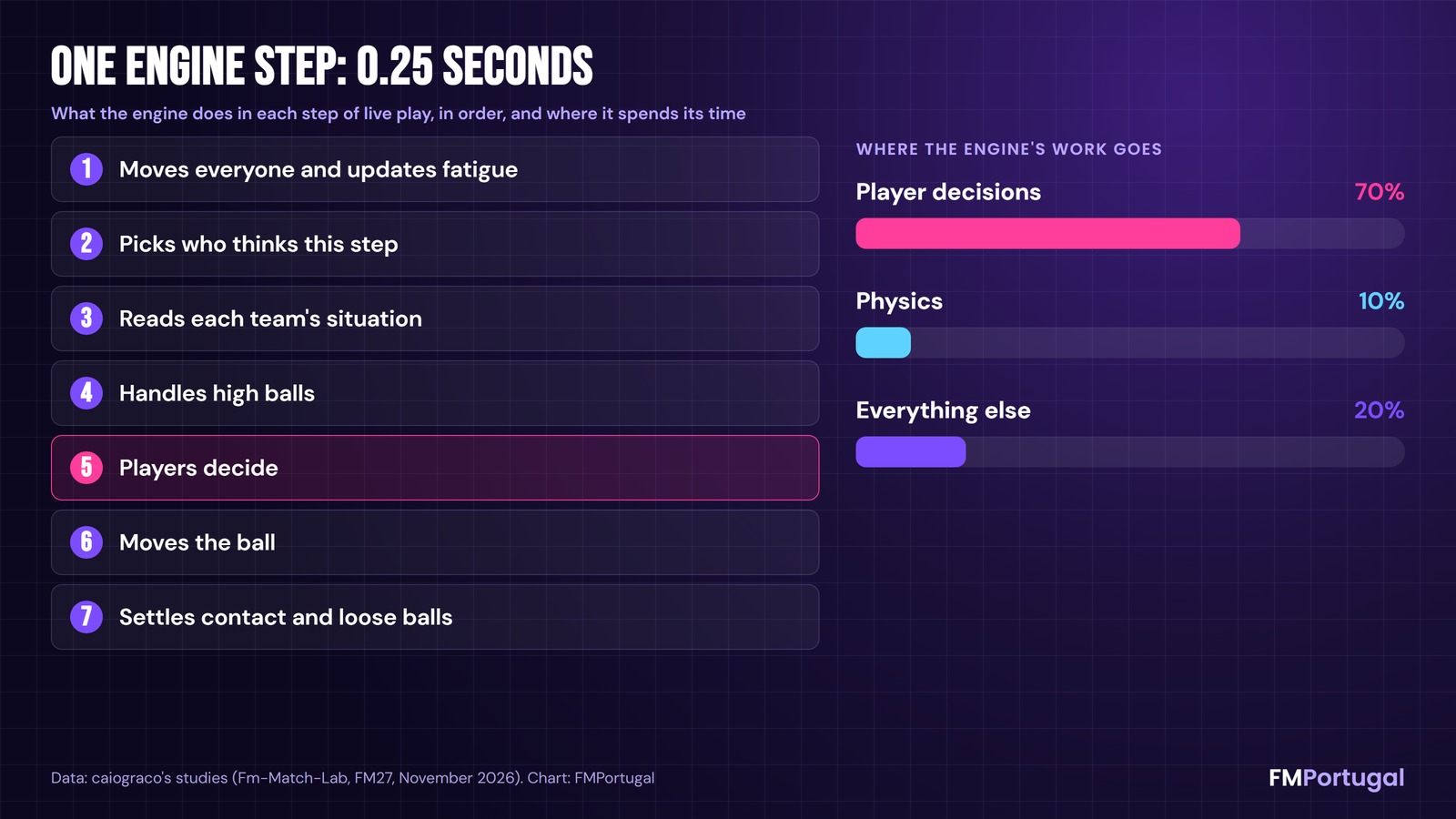
What the engine does in each step and where it spends its time (Image: FMPortugal, with data from caiograco)
The FM27 match engine is a step simulation. Every quarter of a second, every player and the ball move a little, and every decision is taken at one of those steps; nothing happens in between. A match has about 24,000 steps, three quarters of them live play and the rest stoppages, half time and full time.
Also, not everyone thinks at every step: on average only 10 or 11 of the 22 players re-decide at each step, and the rest carry on with their last decision. In some situations, the engine makes a player wait half a second, or a full second if his Concentration die comes up low. In practice, that’s reaction time.
The most surprising part is where the work goes. About 70% is spent on player decisions, half on the man on the ball and half on the other 21 choosing where to be. Physics (running, the ball, aerial balls and body contests) is only a tenth. For example, in a single decision by a defensive midfielder on the ball, the engine read more than 13,000 attribute values in a quarter of a second, and almost all of them belonged to other players: the teammates he could pass to and the opponents who could cut it out.
Effective values and dice: the engine barely reads the profile
This is the key part. Between the numbers you see on screen and what happens on the pitch there are two layers, and caiograco is confident about both.
First, effective values. At kick-off and at several breaks in play, the engine turns each attribute into an effective value: the attribute plus the match modifiers, mostly condition and sharpness. Physical ones fade as a player tires; over one match, a player’s effective Agility, Balance and Acceleration fell by about 10%. So Stamina pays twice: it keeps Pace and Acceleration up to the end.
Then, dice. At the same moments, the engine rolls a die from 0 to the effective value for 28 attributes, and until the next roll much of the play reads the die, not the attribute. Most mental attributes reach the pitch this way. Passing, Finishing and the other ball skills have no die and are read directly.
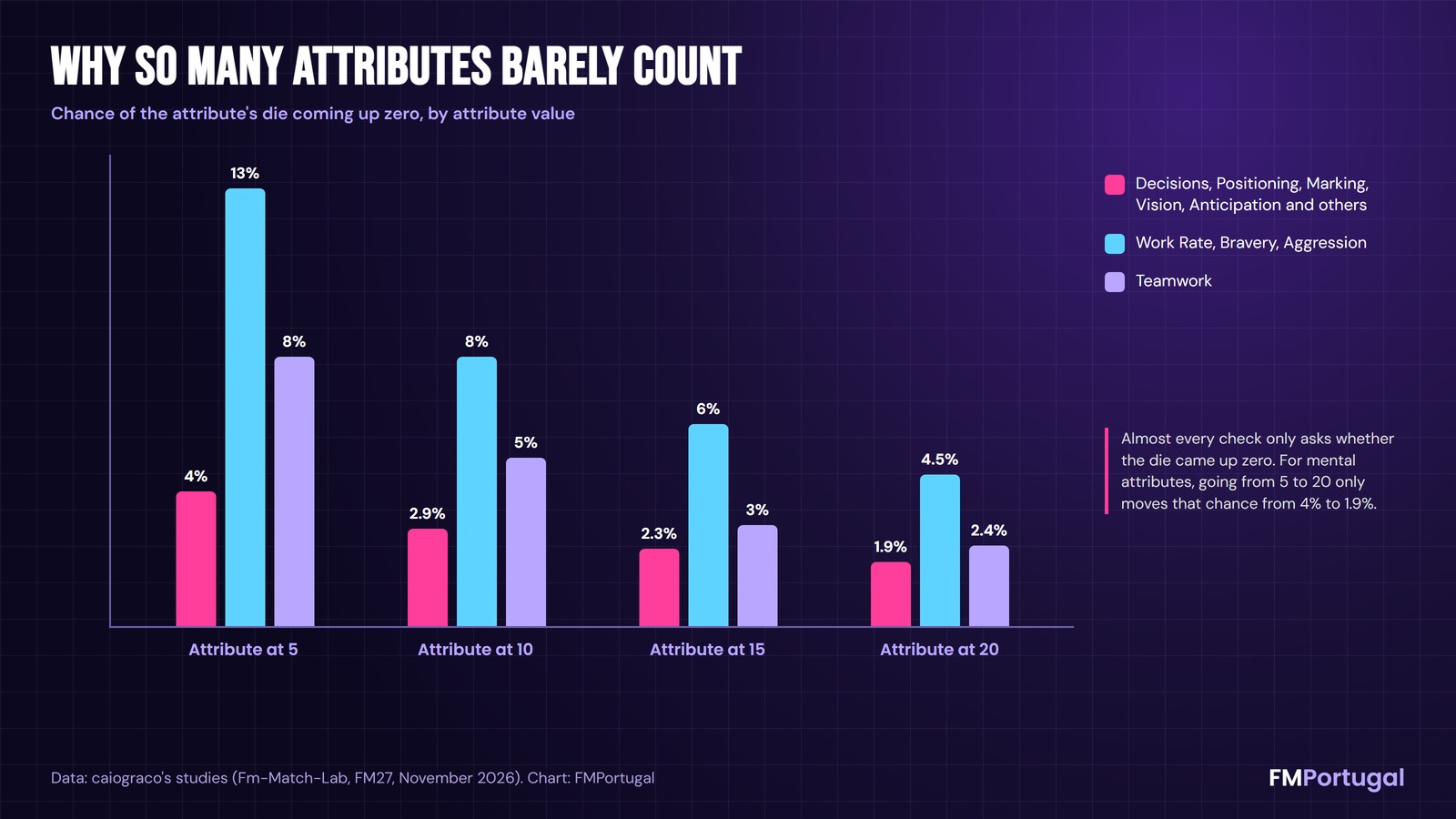
The chance of the die coming up zero barely changes with the attribute (Image: FMPortugal, with data from caiograco)
And here’s the detail that explains everything: almost every check only asks whether the die came up zero. For Decisions, for example, that’s about 255 of 300 checks. A positive die lets the player consider an option or adjust his position; a zero doesn’t. Yet for mental attributes, going from 5 to 20 only moves the chance of a zero from 4% to 1.9%. So Decisions, Positioning and Marking are read hundreds of thousands of times per match and still barely move the result.
On the other hand, Work Rate, Bravery and Aggression sit on a steeper scale: at 5, the die comes up zero 13% of the time. That’s why Work Rate punishes low values and stops counting from about 9.
Finally, the read counts also bust a myth. Per outfield player, over 90 minutes, the engine reads the Vision die about 310,000 times, Anticipation 240,000 and Decisions 210,000. Pace and Acceleration are read only about 25,000 times each, and Finishing about 100. In other words, Pace isn’t read more than the others: it’s read in the places that decide what happens.
The formulas of the physical attributes in the FM27 match engine
Physical attributes have simple, almost linear formulas, checked by the agent in real matches (for a fresh player, on the 1-20 scale):
| Attribute | What it does | At 10 | At 20 |
|---|---|---|---|
| Pace | Top speed: 8.05 + 0.11 × Pace metres per second | 9.2 m/s | 10.3 m/s |
| Acceleration | Getting going, in every “who gets there first” estimate: 2.2 + 0.09 × Acceleration | 3.1 | 4.0 |
| Agility | How fast he turns: 1.55 + 0.0225 × Agility, capped at 2.0 | 1.78 | 2.0 |
| Stamina | How fast he tires above 75% of top speed, compared with a Stamina-20 player | 1.75 times as fast | normal |
| Jumping Reach | Jump height: (Jumping Reach + 5) / 30 metres above standing reach | 0.50 m | 0.83 m |
Several conclusions follow:
- Pace: +5 always gives 6% more speed, in every run and every “who gets to the ball first” estimate. That’s why it’s worth so much.
- Stamina: works twice, because the player tires more slowly when running hard and recovers faster when jogging.
- Strength and Balance: count exactly the same in body contests, the engine’s most frequent check.
- Jumping Reach: about 3.3 cm per point, and a ball out of reach simply can’t be played.
- Dribbling: decides how close to top speed the player runs with the ball, so Dribbling and Pace multiply each other.
The mental attributes with a clear job
Most mental attributes work through their die, but some have a well-defined job:
- Vision and Anticipation: Vision is how far the player sees others, about 40 m at 10 and 60 m at 20. If his Anticipation die also wins, he reasons with where the other player is going, not where he is now. It’s the most-read part of the whole engine.
- Concentration: is reaction time. A low roll makes the player wait a full second, instead of half, before reacting.
- Determination: decides whether the player keeps the better or the worse of two Concentration rolls.
- Off the Ball and Concentration: hold the offside line. With a die of 0 the player can drift up to 2 m off the line; with 20, not at all.
- Decisions, Positioning, Marking and Composure: work as switches, turned on or off by the die, which is why they’re worth so little in the tests.
Shooting and goalkeepers
The attribute used in a shot depends on the distance (confident, according to the author):
| Shot | Attribute used |
|---|---|
| Inside the box (up to 18 yards) | Finishing |
| Between 18 and 22 yards | A blend of Finishing and Long Shots |
| Beyond 22 yards | Long Shots |
| Header | Heading |
| Direct free kick | Free Kick Taking (from range, mixed with Long Shots) |
| Penalty | Penalty Taking |
In other words, Finishing is one of the least-read attributes in the engine, about 100 times per match, yet it decides most shots inside the box. That’s why it converts chances without creating them, and why tables based on expected goals (xG) miss it.
For goalkeepers, Reflexes set how fast he gets to the ball, Agility can cap that reaction, Aerial Reach does what Jumping Reach does for outfielders, and Handling goes into a random check on how much pace he takes off the shot. All of this happens at the save, not before, so it changes goals and not xG. This part is the author’s “best reading”, since it only runs when there’s a shot.
Condition, sharpness and morale
Condition, sharpness, morale and team cohesion go into a single modifier added to every attribute. The agent measured each one’s effect, in attribute points, in one match with one squad:
| Change | Pace and Acceleration | Decisions, Positioning and Marking | Technical |
|---|---|---|---|
| Condition 90% | −0.8 | −0.9 to −1.1 | about 0 |
| Condition 70% | −2.7 | −2.8 to −3.3 | −1.0 |
| Sharpness 80% | −1.3 | −0.7 to −0.9 | −0.2 to −0.5 |
| Sharpness 60% | −2.8 to −2.9 | −1.7 to −2.1 | −0.7 |
| Morale 1 (instead of 13) | 0 | −0.6 to −0.9 | −0.4 to −0.6 |
| Team cohesion 30 (instead of 76) | −0.4 | −1.1 to −1.2 | −0.5 |
So a player at 70% condition plays with almost 3 points less Pace, Acceleration, Decisions and Positioning. Morale, meanwhile, moves almost everything by less than a point, which is why it doesn’t show in results. Club cohesion, unlike team cohesion, isn’t used.
There’s also an explanation for three old questions:
- Pressure: adds a “nerves” term to the same modifier. From 1 to 20, it lifts almost every mental and technical value by a third to half a point. It was the only hidden attribute with a clear effect in the tests.
- Consistency and Important Matches: are a single roll before kick-off, which sets the odds of a “bad day” where the player loses value in every attribute for the whole match.
- Current ability (CA): only acts as a limit, through the gap to potential. For an established player that limit sits at its floor, which is why CA doesn’t count inside the match.
Tactical Effectiveness in the FM27 match engine
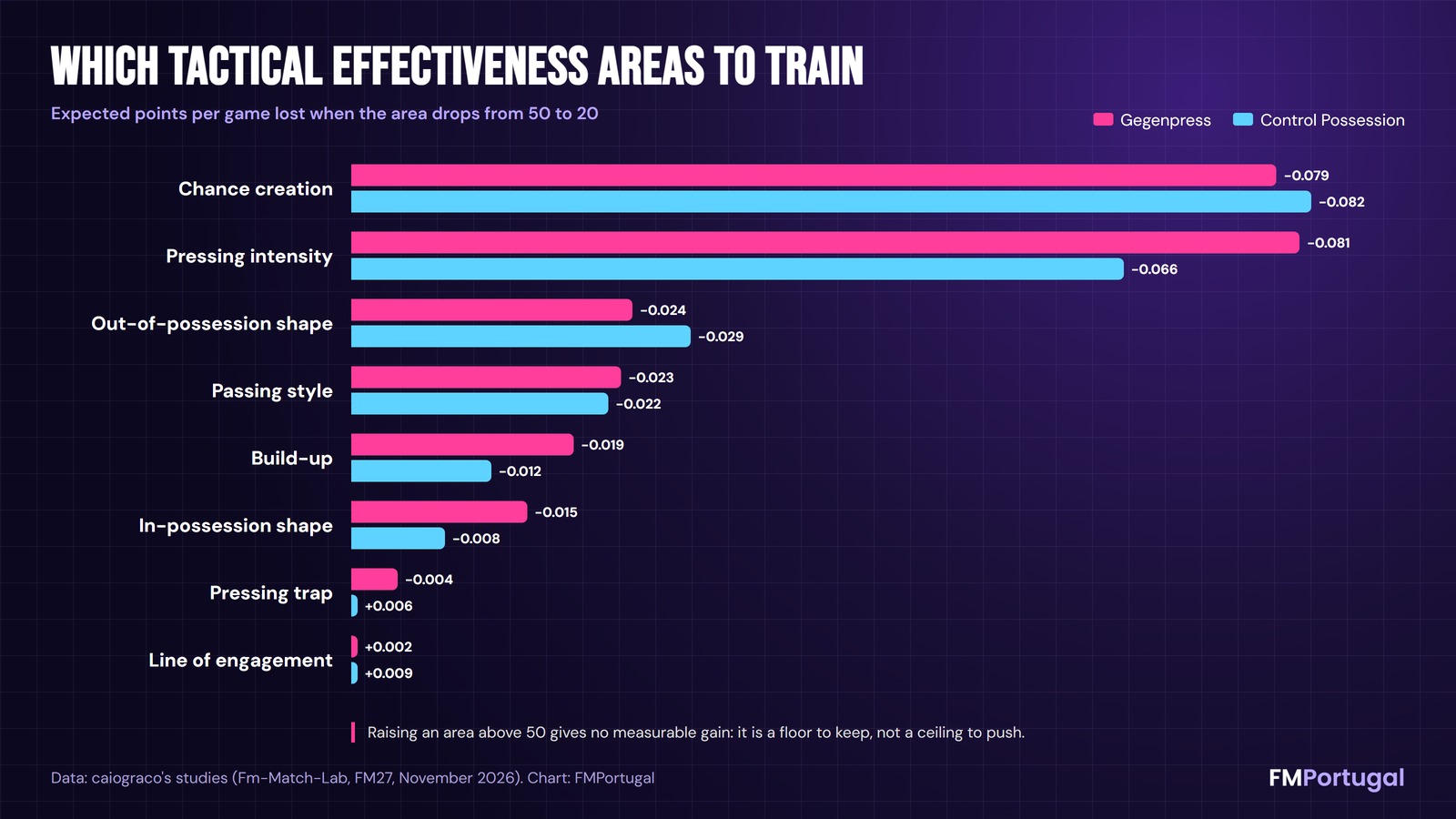
Expected points per game lost when each area drops from 50 to 20 (Image: FMPortugal, with data from caiograco)
Tactical familiarity doesn’t touch effective values: it scales the dice. Each of the eight Tactical Effectiveness areas strengthens two attributes of every player, almost always mental ones, and never the physical ones:
| Area | Dice it strengthens |
|---|---|
| In-possession shape | First Touch and team cohesion |
| Passing style | Decisions and Composure |
| Build-up | Technique and Vision |
| Chance creation | Anticipation and Off the Ball |
| Out-of-possession shape | Concentration and Marking |
| Line of engagement | Work Rate and Aggression |
| Pressing intensity | Anticipation and Tackling |
| Pressing trap | Decisions and Positioning |
The multiplier runs from 0.5, when the area is below 16, up to 1.6, between 91 and 100. From this, squirrel_plays suggested training only the areas that affect the most valuable dice, and caiograco tested it over 27,200 matches. It held up: chance creation and pressing intensity are the two that count, because they’re the two tied to Anticipation. Letting them drop from 50 to 20 costs about 0.08 points per game, around 3 points a season, in both Gegenpress and Control Possession. On the other hand, raising any area above 50 gives no measurable gain: it’s a floor to keep, not a ceiling to push. To learn how to train them, see our guide How to improve Tactical Effectiveness in FM27.
Instructions, roles and traits
Team instructions reach the pitch in three ways. Width, defensive line and mentality move positions at kick-off; for example, “much deeper” puts the line 1.5 m deeper. Others, such as passing length, dribbling or shooting from distance, become switches that decisions check all the time. The rest, such as the pressing trap or counter-press, are only checked at the moment they apply.
Player traits are also switches inside about 20 decisions. They change what the player tries, not how well he does it:
| Trait | What it changes |
|---|---|
| Shoots From Distance | Considers shooting from up to 30 m instead of 20 m, if instructions allow it |
| Avoids Long Shots | No shots from 20 to 30 m |
| Tries To Break Offside Trap | Stands 1.5 m off the last defender instead of 3 m |
| Tries Killer Balls Often | A pass towards goal no longer needs a Vision roll of at least 16 |
| Plays Short Simple Passes | The safe short pass becomes the choice whenever passing directness is below 12, instead of 7 |
| Possesses Long Flat Throw | +8 m on long throws |
For example, Shoots From Distance adds 2.5 shots per match, but all from 20 to 30 m and worth very little. As for roles, another player, ashibarshin, concluded with their own agent that roles change behaviour and positioning, not the weight of attributes.
Home advantage
Interestingly, the engine doesn’t give the home side a direct boost during the match. Before kick-off, each manager works out an expected goal margin, with a bonus for the home side: between equal teams, the home side expects about +1.26 goals and the away side −0.76. That expectation affects the manager’s confidence, the AI’s tactical choices and discipline. Still, this explains at most a fifth of home advantage, and the rest hasn’t been found in the code yet.
What about update 27.1?
Update 27.1, on 18 November, shipped a new match engine with about 50 changes. caiograco compared both versions over 1,500 matches: matches got a little scrappier, with 0.8 percentage points fewer completed passes and 1.6 more shots per match, but each shot is worth less and total expected goals didn’t change. Results barely moved. Also, the old engine is still inside the game, behind a version switch, and replays old matches goal for goal. So studies done on 27.0.1 remain valid. For the rest of the update, see our article on update 27.1.0.
What this changes in your save
- When signing players, Pace, Acceleration, Stamina and Jumping Reach still rule, and now you know why.
- Rotate your squad: condition and sharpness take several points off effective attributes.
- In Tactical Effectiveness, don’t let chance creation or pressing intensity drop below 50. Pushing areas beyond that doesn’t pay.
- Pick player traits for the style you want, not for extra value: they change what players try, not how well they do it.
Be careful
First, this is AI-assisted reverse engineering, with no confirmation from Sports Interactive. Also, part of what’s here is the author’s “best reading”, especially on goalkeepers, Work Rate and roles. The condition and morale numbers come from one match and one squad. Finally, it’s not yet known whether quick simulation and matches in leagues you don’t follow use the same full engine.
Our take
This is the work that was missing to understand the FM27 match engine. After knowing how much each attribute is worth, now we understand why: the game really does simulate 22 players seeing, deciding and running, but the way it uses dice means many attributes show up everywhere and barely change the result. In the end, that’s not a bad sign for the game; it’s mostly a matter of weights Sports Interactive can tune.