The Hull 433 FM27 tactic is the most viewed tactic in the Korean FMKorea community, with about 70,000 views. Its author, Wizard마틴, took Hull City, a club fighting relegation, into the Champions League. To do it, he gave up building from the back and went for direct football, which he calls «Kick and Rush». Also, the tactic has three plans, one for each opposition shape.
The three plans
What sets this tactic apart is that it changes with the opponent’s in-possession shape. So before each match, the author checks the opposition report and picks the right plan. If the opponent changes formation after kick-off, he switches plan too.
- Plan A: first, against teams in 4-2-3-1, 4-2-4 or 4-4-2. Out of possession, the team closes into a 4-1-4-1 block.
- Plan B: against the 4-3-3. Out of possession, it forms a triangle of three midfielders.
- Plan C: finally, against teams with three centre-backs, such as the 3-4-3. Out of possession, two central midfielders press high, the wingers push up and the team counter-attacks through the middle.
All three plans are available to download below.
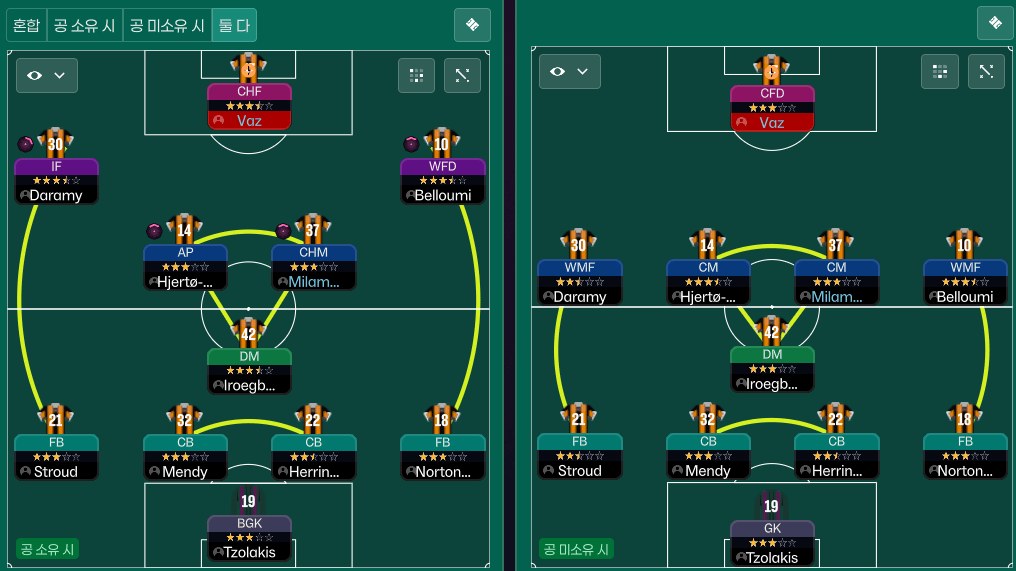
Plan A, in possession on the left and out of possession on the right (Image: Wizard마틴)
Roles and game plan
In possession, the team plays a 4-3-3, with a defensive midfielder behind a Channel Midfielder and an Advanced Playmaker. Up front, there is an inside forward on the left, a wide creator on the right and a lone striker. At the back, the centre-backs and full-backs have simple roles, because this is a team fighting relegation. So the tactical complexity stays low.
The idea is to move from defence to attack quickly. For example, the full-backs spread out, the centre-backs pass it between them and, as soon as a midfielder gets the ball, he plays it straight to the far-side forward. Then the two wide forwards, the playmaker and the defensive midfielder all push up at once.
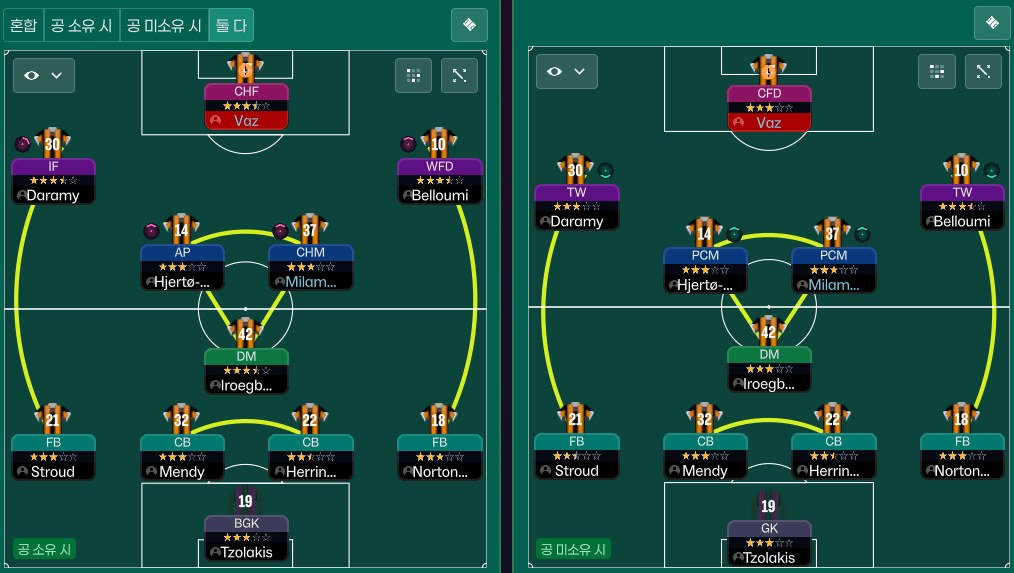
Plan C, for playing against three centre-backs (Image: Wizard마틴)
The team instructions
In possession, passing is more direct, the tempo higher and the attack wider, with a counter-attack in transition. Also, the team passes into space, tries to play through the press in build-up and plays goal kicks short to the centre-backs. In Plan C, the author turned patience off, because against three centre-backs it is hard to break down a defence with so many players.
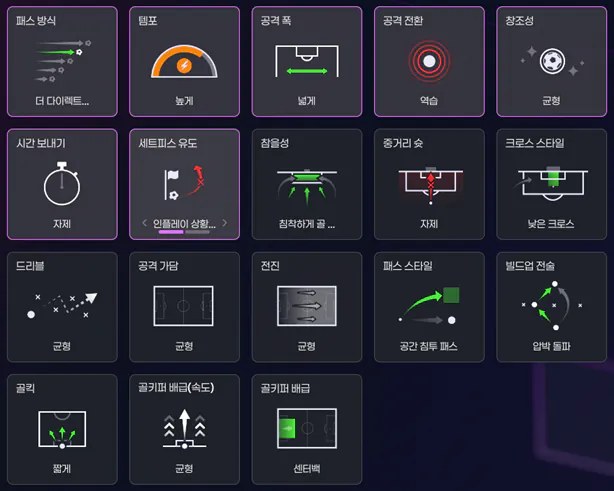
The in-possession instructions, with the changes in purple (Image: Wizard마틴)
Out of possession, the team presses high and more often, counter-presses and keeps a normal defensive line. On the other hand, tackling stays normal, to avoid cards.
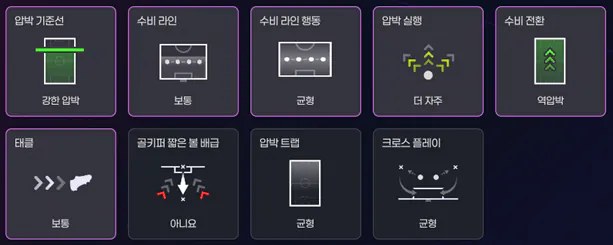
The out-of-possession instructions (Image: Wizard마틴)
The results with Hull City
The author admits he almost did not post the tactic, because Hull drew and lost a lot of games, had a losing run mid-season and finished with four draws in a row. Even so, they reached a Champions League place. The goals mostly went to the on-loan striker, Vaz, and Belloumi, who creates on the right, was the league’s top assist maker.
The author’s tips, translated
- Training: first, create your manager with a high reputation and use team cohesion and tactical understanding training. Team cohesion training can be done twice a week.
- Core XI: quickly work out who performs in each position and play them, so your XI gets familiar with the tactic. Between games, change only two to four players.
- Praise: praise training every one or two weeks, for players with a training rating of 8 or more.
- Winter signings: do not start January signings straight away, because their tactical effectiveness is low. So sign mainly in the summer and bring new players in from the bench or at home first.
- Tough games: in derbies and away games, always play your best XI.
- Feet and traits: the channel midfielder should play on his natural foot, and the playmaker preferably on his weaker side. Also, forwards should not have the trait of coming deep to get the ball.
- Players: up front, pace. At centre-back, speed and aerial ability. Finally, the defensive midfielder needs at least 11 for aerial ability, preferably 12 or more.
- No shortcuts: the author did not use holiday or instant result, because then the AI or the assistant decides. To go faster, he recommends text commentary.
- Picking the team: do not use quick pick, because it messes up the tactic. If you do, load the tactic again.
- Cards: for a booked player, set the tackling player instruction to «ease off», and set it back when you take him off.
What the author explained in the comments
In the comments, the author answered many questions. First, he shared each player’s individual instructions:
- Striker: get further forward and shorter passing.
- Inside forward: stay wider.
- Right-sided wide forward: take more risks with passes.
- Playmaker: dribble less and roam from position. The channel midfielder also roams.
- Full-backs: sit narrower, get further forward, shoot less and cross from the byline.
- Centre-backs and defensive midfielder: shoot less.
Also, the links between players, the lines shown on the tactics screen, form when the same players play and win together several times. So if you rotate a lot, you may go a whole season without seeing them. Finally, the author warns that training needs balance: too much tactical understanding training holds back player development, but too little lets familiarity drop below 50% quickly. The training schedule he recommends is for a one-game week. So when there are two games, give a day off after the match and fit the lost sessions into free days.
Hull 433 FM27 tactic download
- Plan A: Download – Hull 433 FM27, Plan A
- Plan B: Download – Hull 433 FM27, Plan B
- Plan C: Download – Hull 433 FM27, Plan C
- First, download the
.fmffiles for the plans you want. - Then copy them into
Documents\Sports Interactive\Football Manager 27\tactics. If thetacticsfolder does not exist, create it. - Next, start the game, go to the Tactics screen and load each plan from the tactic menu, using the import option. FM27 lets you keep up to three tactics.
- Finally, before each match, check the opponent’s formation in the report and pick the right plan.
Mind the Tactical Effectiveness
The author sums FM27 up well himself: the tactic is only one part, because the team’s and each player’s Tactical Effectiveness weigh a lot, and teams with low scores almost always lose. So this tactic may not work for every team. Also, having three plans helps, but the squad has to train all of them, and the main one will always be the most familiar. Finally, the author warns that if the match engine changes at full release, the tactic may stop working.
For other counter-attacking ideas, see the 2-3-4-1 counter-attacking tactic, and for training, the FM27 training schedules.
The tactic is by Wizard마틴, posted on the FMKorea community. FMPortugal only points to the files — all credit goes to its creator.