Some players go down in video game history for being legends on screen. Others, far rarer, become legends precisely because they never set foot on a real pitch. That is the case of Tó Madeira, and of a whole generation of ghost “stars” he dragged along with him into Championship Manager 01/02, and who inspired others in different countries.
A Coimbra student who reinvented himself
It all began in the 2000/01 season. António Lopes, a civil engineering student from Gouveia who was living in Coimbra, was one of the volunteers recruited by Sports Interactive to fill in the database for the Portuguese lower divisions. In much of the world, the system relied on local fans who knew the amateur leagues better than any professional scout, and who worked with very little supervision. Lopes had played for Clube Desportivo de Gouveia’s youth team without ever going any further, and he saw the perfect chance to reinvent himself. He added himself to the game under his childhood nickname, “Tó Madeira”, still with modest attributes, far from drawing any attention.
The striker who put Figo, Zidane and Ronaldo to shame
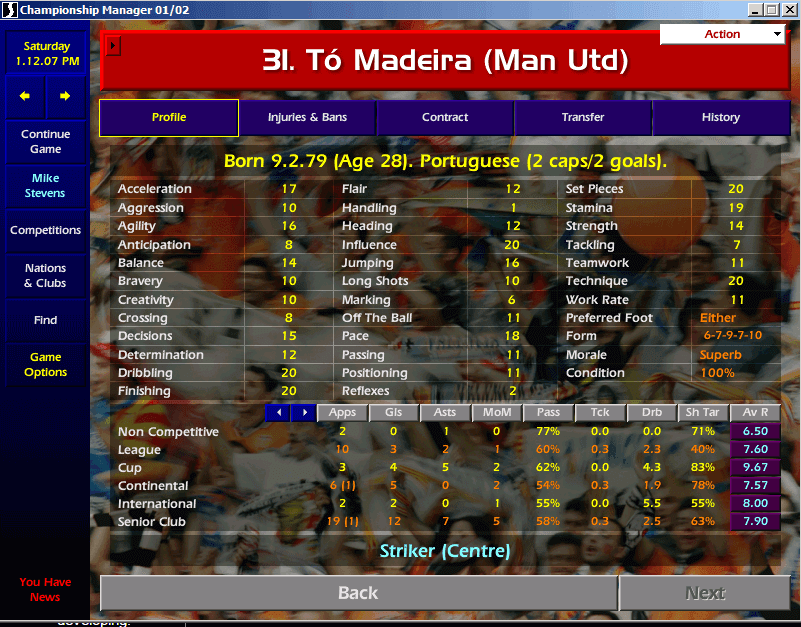
The following season, 2001/02, with the brakes off, Lopes turned his striker into a goal machine: more than 50 goals a season, with free kicks and penalties worthy of a Cristiano Ronaldo ahead of his time. In a ranking of the best fictional players of that edition, the striker has better attributes than real names such as Montella, Crespo or Batistuta. There was no Figo, Ronaldo or Zidane who could outshine him. Whether in London, Madrid, Lisbon, Rio de Janeiro or Shanghai, he was the first name every virtual manager wanted to sign.
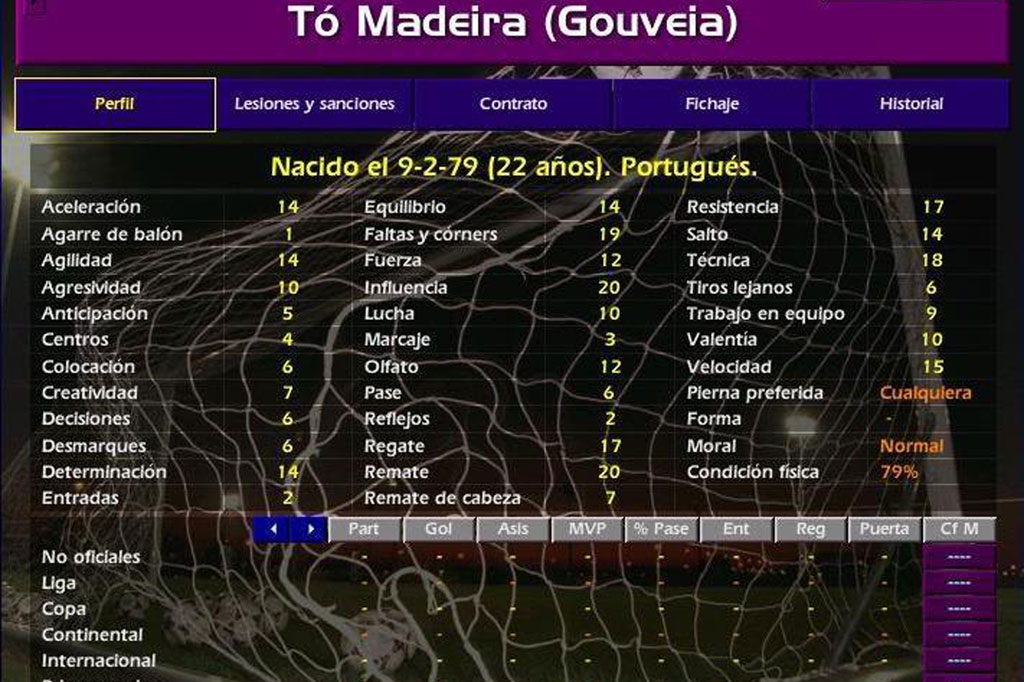
His fame jumped from the screen to the real world. English clubs that already used the game’s database to look for signings (Arsène Wenger himself was said to be an occasional user) started calling Sports Interactive to ask about this Portuguese phenomenon no real scout had ever heard of. Intrigued, the developer contacted the Portuguese research team and even phoned Clube Desportivo de Gouveia itself, until the truth came out.
The Paralta brothers: the classmates who also “conquered” the world
Tó Madeira did not play alone. Lopes used the same privileged access to the database to invent profiles for school friends, among them the Paralta brothers (André and João), all with world-class ratings. The pair stuck so firmly in the collective memory of Portuguese fans that, years later, they were still mentioned alongside Tó Madeira himself as essential figures of that edition. An article on the Bola na Rede website, dedicated to an eleven of the best fictional gems of CM 01/02, recalls precisely that cult quartet: Hugo Pinheiro, the Peralta “bros” and Tó Madeira, names that still echo today among those who grew up managing virtual clubs at the turn of the millennium.
Unlike Tó Madeira, the Paraltas never caused the same international stir, nor did they lead Sports Interactive to phone Portugal to investigate. They survived more as an inside joke between childhood friends than as a global phenomenon. But they are part of the same founding myth: proof that, in an era when volunteer researchers had direct and barely supervised access to the database, all it took was a student with a sense of humor to turn his entire high school class into world-class stars.
A global community of “almost unknowns”
Portugal was not the only country to produce legendary ghosts. A series of articles devoted to the “almost unknowns” of Championship Manager recalls how every country had its own pantheon of players that the most experienced fans signed blindly, confident they would soon be winning titles. Belarusian Maxim Tsigalko was seen as the greatest star in the series’ history, with maximum finishing at just 18, even though a Sports Interactive fix drastically cut his abilities in a later update. Alongside the Portuguese João Paiva, other names such as Alessandro, Adrian Mihalcea or Sergey Nikiforenko suffered similar fates, losing some of their shine after successive bug fixes.
In Greece, the “Super Greeks” became famous Papadopoulos and Skalidis, genuine statistical freaks, so inflated were their ratings. In Brazil, a trio made up of Guilherme, Zé Afonso and Dodô became synonymous with a guaranteed bargain, with European clubs offering around twenty million dollars for one of them in the very first seasons. And, alongside them, real names such as Nigerian Taribo West, available for free in version 01/02, or the “Vila boys” Diego and Robinho, undisputed legends of the 03/04 edition, as were the then prodigies Freddy Adu and Pazzini.
Tó Madeira and the Paraltas, however, are still remembered as the purest example of the genre. Not just for being overrated, but for not existing at all, to the point that the game’s own developer opened an investigation to find out who they were.
The sacking and the update that erased him
António Lopes was fired by Sports Interactive as soon as the hoax was uncovered. In February 2002, an update officially removed Tó Madeira from the game. Later, he would joke that the player had suffered a very serious knee injury, the only way to explain the sudden disappearance of the greatest goalscorer in Portuguese virtual football.
The London club that took his name
The legend did not die with the sacking. In 2011, two former Sports Interactive employees, Stuart Warren and Michael Burling, founded an amateur club in London named in his honor: FC Tó Madeira, born from a simple joke between former colleagues. The irony is that the club came nowhere near living up to the name on the pitch. In its first season, it finished last out of nine teams, with just one win, one draw and fourteen defeats, an almost comical contrast with the goalscoring legend that gave it its name. As one of the founders later admitted, they lacked exactly that special touch that had made Tó Madeira unforgettable, although they also conceded that a player like that would hardly let himself be “tamed” by an amateur club in London.

A database that never died
Part of the reason these legends have lasted two decades is that the game itself never really disappeared. In 2009, Eidos, which owned the rights to the Championship Manager brand, decided to make CM 01/02 available as a free download from its own website. Since then, a dedicated community has kept the database and squads updated almost in real time, more than twenty years after the original release, proof that nostalgia for that “good old” text-based simulator, with no graphics engine and none of the complexity of today’s games, is still very much alive among those who started playing as kids.
Twenty years later, YouTube does him justice
Mais de duas décadas depois de ter sido apagado da base de dados, o Tó Madeira voltou, desta vez a sério, ou quase. A Betclic lançou, em novembro de 2025, “Tó Madeira: em busca de uma lenda“, uma mockumentary apresentada pelo humorista Luís Franco Bastos, que mistura arquivo, entrevistas e uma viagem até aos balneários de Gouveia para tentar separar mito de realidade. O lançamento coincidiu, não por acaso, com a chegada mundial do Football Manager 26, sucessor direto daquele Championship Manager onde tudo começou.
Franco Bastos, a regular player of the series since his teens, sums up the obsession behind the project well: he refuses to accept that the goals and trophies he celebrated over so many hours of play might, after all, have been a lie. The series was released on the brand's YouTube channel and sparked instant waves of nostalgia across international fan communities of the game, many of whom believed the legend did, in fact, have a real and documented origin.
A legend bigger than reality
Perhaps there never was a flesh-and-blood Tó Madeira. But few players, real or invented, have left such a lasting mark on those who spent their teenage years managing virtual clubs on a slow computer, hoping that unknown striker from Gouveia, and his classmates turned global phenomena, would keep scoring impossible goals. Twenty-five years later, between documentaries, amateur clubs named in his honor and communities that still update the database, the answer seems ever clearer: sometimes, the best football story doesn’t even need to have happened.
Read also